


You're showing up on Google, your reviews are decent, and people are clicking your profile. Yet your chairs are sitting empty. The problem is almost never your visibility. It's what happens the moment someone tries to reach you.
The Gap Between Views and Bookings Is Not a Marketing Problem
If you've been running your salon for a few years, you know the difference between a quiet period and something that feels structurally wrong. A quiet November is expected. A Google profile that shows 400 views in a month and produces three bookings is not a seasonal issue. It's a systems issue.
When bookings are low, the instinct is to push harder on marketing. Post more content, run a promotion, try ads. And sometimes that's the right call. But if your conversion rate from inquiry to confirmed appointment is low, spending more on attracting people into a broken process doesn't fix anything. It just makes the problem more expensive. Most salons that struggle here are already making a handful of the same marketing mistakes without realising it.
Views on your Google Business Profile represent people who found your salon, thought it looked worth a second look, and clicked in. Getting found in a local market with dozens of competitors takes real work. The person on the other end of that click was already thinking about booking. What happens next is entirely within your control, and for most salons, that's exactly where revenue is being left on the table.
Where Clients Actually Drop Off — The Full Booking Journey
Most salon owners think about the booking journey as two steps: someone finds you, then they book. In reality, there are four or five points where a client can and does walk away. Understanding where the drop-off happens tells you exactly what to fix.
The drop-off points that affect established salons most are stages three and four below, not the top of the funnel where most people focus their attention. A client who has found you, clicked your profile, and sent a message is already most of the way there. Losing them at the response stage is one of the most avoidable revenue leaks in the business.
Stage 1: Client searches "hair salon near me" on Google Maps
Your profile appears. They see your name, star rating, and a photo. They click through. If people are finding you, your local SEO is doing its job.
Stage 2: Client reads your reviews and browses your photos
They're deciding whether you're worth the risk of trying. If your profile is reasonably complete and your rating is above 4.0, most people will make it past this point.
Stage 3: Client decides to inquire and hits friction
This is where most salons start losing people. The available options are often: call the salon during business hours, click a website link that's often not mobile-friendly, or send a DM on Instagram. If it's 8 pm on a Thursday, the call goes to voicemail. The website button leads to a contact form. The Instagram DM sits unread. A lot of this starts with how your Google Business Profile is set up and what a potential client sees when they land on it.
Solution? - Zoca's AI Front Desk Agent is built to solve this. It answers inquiries across channels around-the-clock, assists clients in booking an appointment. This way, no call goes unanswered.
Stage 4: Client waits for a response and doesn't get one quickly enough
Research from the MIT and InsideSales.com Lead Response Management Study, which analysed over 15,000 leads and 100,000 contact attempts across six companies, found that the odds of making contact with a lead drop over ten times within the first hour of them reaching out. For a client comparing two or three salons, whoever responds first often wins the booking, regardless of who does the better work.
Stage 5: Client books with a competitor who was available
They didn't choose the competitor because they preferred them. They chose them because booking was faster and easier. You never knew they had considered you.
Why Response Speed Is the Factor Most Salon Owners Underestimate
A Harvard Business Review found that businesses that contacted leads within one hour of receiving an inquiry were nearly seven times more likely to have a meaningful conversation with that potential client, compared to those who waited 60 minutes. Those who waited 24 hours or more were 60 times less likely to convert.
This covers service businesses broadly, not salons specifically. But the principle applies directly. When someone messages your salon, their intent is at its highest in that moment. Every minute that passes without a response is a minute in which they might find another option, get distracted, or simply talk themselves out of booking.
What makes this harder for salons is that the people most capable of responding quickly are also the ones with their hands occupied. The owner or stylist who would give the best response is mid-appointment. Manually managing inquiries is not a problem you solve by trying harder. It requires a different system entirely.
The After-Hours Problem Nobody Talks About Enough
According to research, 46% of bookings happen outside salon opening hours, with 28% in the evening after salons close and 18% in the early morning before they open.
That figure has direct implications for how you set up your operations. Roughly half of all people trying to book your salon are doing so when no one is available to respond. If a client finds you on Google at 10 pm, sends a message, and hears nothing back until the following morning, one of two things has happened by then: their intent to book has cooled, or a competitor has already confirmed their appointment.
This is not a flaw in your marketing. It's a structural gap in your availability, and it's one of the clearest reasons why the views-to-bookings problem cannot be solved by posting more content or running better ads.
What Handling Inquiries Manually Is Actually Costing You
Many salons that recognise the response problem try to solve it by hiring a receptionist or front desk coordinator. For high-volume salons, that can be the right call. But it's worth being clear-eyed about what you're getting.
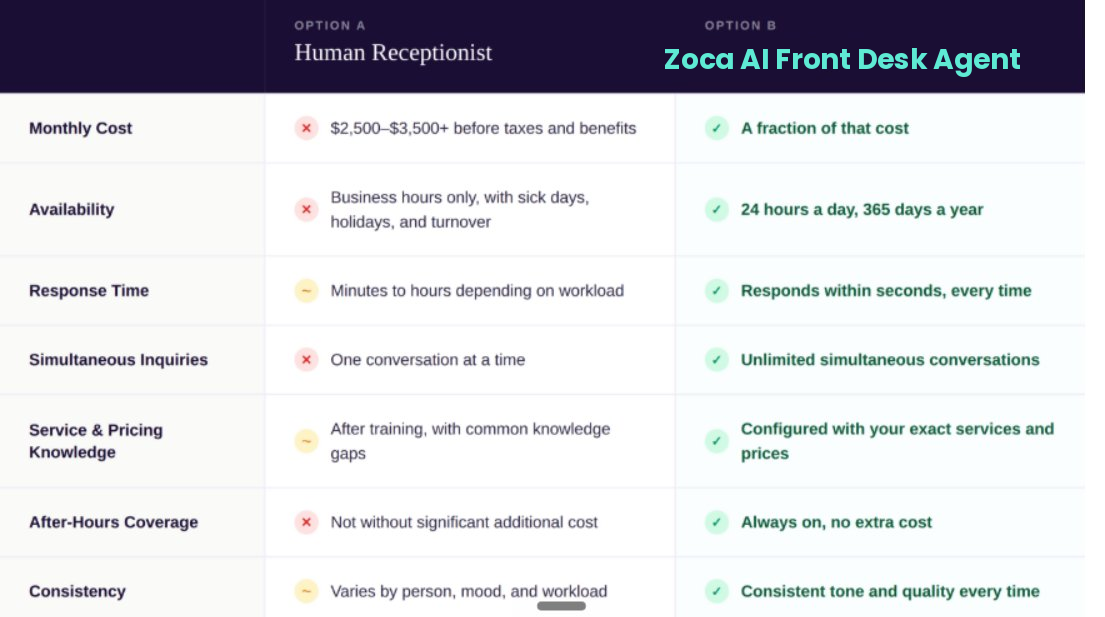
The point here is not that human receptionists are a poor choice. For some salons they are absolutely the right one. The point is that if your current process relies on yourself or a staff member to answer inquiries between appointments, you are guaranteed to miss the after-hours window, and you are likely too slow during business hours to consistently capture inquiries before a competitor does.
What to Fix First If You Want Inquiries to Become Appointments
The fixes below are ordered by where the conversion actually breaks down, starting with the point where most salons lose clients before they even know they had them.
1. Respond to every inquiry within minutes, at any time of day
This is the highest-impact change you can make. The research is unambiguous: the faster you respond, the higher the probability that the person on the other end still books with you. For most salons running manually, this is also the hardest to execute consistently because you're in appointments, not watching your inbox.
The practical fix is removing the human bottleneck from initial response entirely. The first reply doesn't need to come from you. It needs to come fast, it needs to be warm, and it needs to move the conversation toward a booking. Whether that's through an AI agent or a dedicated staff member with a clear response SLA, the goal is the same: no inquiry waits more than a few minutes, regardless of the hour. Response speed is one piece of what actually moves the needle on getting more salon clients consistently.
2. Make sure your first response actually guides the client toward booking
Speed alone isn't enough if the reply doesn't do any work. A generic "Thanks for reaching out, we'll get back to you soon" buys you nothing. It just delays the same drop-off by a few minutes.
A response that converts does three things: it acknowledges what the client is asking about specifically, it answers the most obvious question (usually availability or price), and it offers a clear next step. Something like: "Hi Sarah, thanks for reaching out about microblading. We have availability this Tuesday at 2pm or Wednesday at 4pm. Would either of those work for you?" That's a conversation with a direction. Most clients will respond to that.
3. Cover the hours when you aren't working
If 46% of salon booking attempts happen after hours, your conversion system needs to work when you don't. This means having a response pathway that doesn't depend on anyone being at the front desk, one that can answer questions about services and prices, check availability, and confirm an appointment at 10pm on a Sunday just as reliably as it would at 11am on a Tuesday.
4. Handle multiple inquiries at the same time
During busy periods, a Saturday morning after a week of posts or a promotional push, inquiries can stack up. A single staff member handling responses one at a time will inevitably leave some waiting too long. The conversion cost of that queue is real. Whatever system you put in place for inquiry management needs to handle volume without response time degrading.
5. Follow up when clients don't respond
Many potential clients drop off mid-conversation not because they changed their mind, but because they got busy. A single follow-up message sent 24 hours later recovers a meaningful share of those conversations. Most salons don't do this because following up manually is time-consuming and easy to forget. Automating it removes that friction entirely.
How Zoca's AI Front Desk Agent Handles All of This
Win Agent is Zoca's AI AI Front Desk agent built for salons, spas, and beauty businesses that need every inquiry to turn into a confirmed appointment. When a new inquiry comes in through SMS, web chat, or voice, it responds within seconds. It knows your services, your prices, and your current availability. It can hold a real back-and-forth conversation, answer the questions clients typically ask before committing to a booking, and take them through to a confirmed appointment.
For salon owners who are in back-to-back appointments all day, or who simply aren't available at 10 pm when someone reaches out, this closes a gap that's genuinely hard to close any other way. You don't need to hire someone to watch your inbox. You don't need to check your phone between clients. Every inquiry gets a real, informed response the moment it comes in.
Win Agent also handles the follow-up side of things. If a client goes quiet mid-conversation, it sends a follow-up at a sensible interval rather than letting the conversation die. It sends appointment reminders to reduce no-shows. If a client hasn't been in for 60 days, it reaches out with a message to bring them back in.
Most salons that struggle with the views-to-bookings gap don't have a visibility problem. They have an availability problem. Win Agent is one practical way to solve it, without adding headcount or changing how you run your day.
Book a free demo to turn every inquiry into a conformed appointment.
Frequently Asked Questions
Why does my salon get views but no bookings?
In most cases, the problem is not visibility. It's response speed and friction. Research from Harvard Business Review shows that businesses contacting leads within one hour are nearly seven times more likely to convert versus those who wait. For salons, this is compounded by the fact that 46% of booking attempts happen outside business hours, when no one is available to respond. A potential client who sends a message at 9pm and hears nothing back until the next morning has likely already booked somewhere else.
How quickly should a salon respond to an inquiry?
As fast as possible. The MIT and InsideSales.com Lead Response Management Study found that the odds of making contact with a lead if you respond within 5 minutes versus 30 minutes drop 100 times. For salons managing inquiries manually, that window is almost impossible to hit consistently, especially outside business hours or during busy appointment slots.
How much does it cost to hire a salon receptionist versus using an AI agent?
A full-time front desk receptionist in the US typically costs between $2,500 and $3,500 per month in salary alone, before taxes, benefits, and training time. They are also unavailable overnight, on weekends, and during sick leave. An AI agent handles inquiries around the clock at a fraction of that cost, with no gaps in availability and no training lag when your service menu changes.