


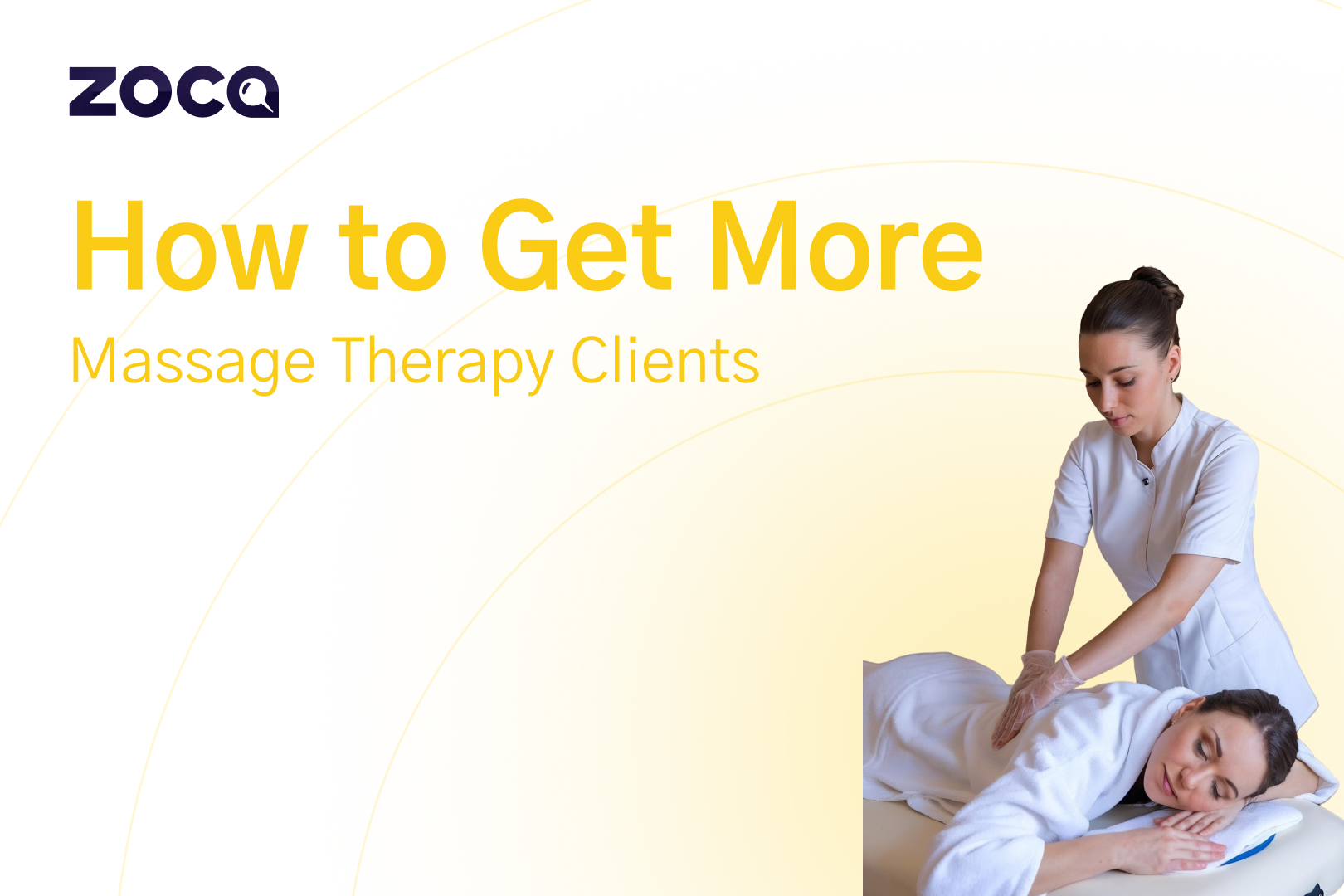
Getting more massage therapy clients comes down to three things:
- Being found when someone searches nearby
- Responding fast enough to secure the booking
- Giving clients a reason to come back
Most massage therapists are excellent at their craft, but have no real system for any of those three. That is why caseloads stay inconsistent even when the quality of every session is outstanding.
You can build a steady, reliable caseload without running paid ads or posting on social media every day. The clients are already searching. They are already looking for someone like you. The gap is almost always visibility, response speed, and follow-up, not the quality of your work.
Zoca works with over 1,000 salons, spas, and wellness businesses across the US. What you are reading is grounded in what actually moves the needle for independent therapists and small practices, not marketing theory.

Why Getting More Massage Clients Is Harder Than It Should Be
You already know your craft. The problem most massage therapists run into is not skill. It is visibility and systems. The demand is genuinely there and growing. Employment of massage therapists is projected to grow 15 percent from 2024 to 2034, much faster than the average for all occupations, according to the U.S. Bureau of Labor Statistics. More people are actively looking for massage therapy than at any point in the past decade. The issue is that finding those people and converting their interest into booked appointments requires a layer of marketing and follow-up that most therapists have never been taught.
The challenge is compounded by how clients actually find therapists. Most people do not call a number from a flyer. They search Google, look at the top three results on Google Maps, read a few reviews, and message or call the first therapist who looks credible and available. If you are not in those top three map results, you do not exist to most of the people who need you most.
Even therapists who do show up often lose clients in the next step: response speed. If someone reaches out after your working hours and hears nothing back until the next morning, there is a real chance they have already booked with someone else. Visibility without a fast follow-up system is wasted effort. This guide addresses both.
How to Get More Massage Therapy Clients: 7 Proven Steps
Step 1: Optimise Your Google Business Profile First
Your Google Business Profile (GBP) is the single biggest lever you have for getting found by new massage therapy clients without paying for ads. It determines whether you appear when someone searches 'massage therapist near me' or 'deep tissue massage in (city).' Most therapists either set it up once and forget it, or never fill it out properly to begin with.
To rank well in local search, your profile needs to be complete and actively maintained. Fill in every field:
- Services with descriptions and pricing
- Hours, including holiday hours
- Service area and a direct booking link
- At least ten recent photos of your space, table setup, and anything that gives a new client a feel for the experience
Businesses with a complete Google Business Profile can get up to 72% more visits compared to incomplete listings.
If you want a quick audit of where your profile stands right now, Zoca's GBP Optimizer shows you exactly what is missing and what to fix first.
Step 2: Get Found in Local Search Beyond Your GBP
Your Google Business Profile gets you into the map results. Your website and local SEO get you into the organic results below the map. Both matter, and the therapists with the most consistent caseloads show up in both places.
For local search, your business name, address, and phone number need to be identical across every online directory where you are listed, including Yelp, Healthgrades, Bing Places, and any local wellness directories. Search engines use this consistency to confirm your credibility. Inconsistencies across listings suppress your ranking.
On your website, include location-specific language naturally throughout your pages. 'Licensed massage therapist in (city) offering deep tissue, Swedish, and prenatal massage' is more useful to Google than 'experienced therapist offering quality sessions.' Your service pages should mention your city and neighbourhood. If you have not done this, it is one of the fastest ranking improvements you can make. The tactics behind local SEO for salons and spas apply directly to massage therapy practices, too.
Step 3: Respond to Every Inquiry Within Five Minutes
This is the single most common reason massage therapists lose clients they earned through good SEO. Someone searches, finds you, likes what they see, and sends a message or calls. If they hear nothing back within an hour, most move on. If they hear nothing until the next morning, almost all do.
The research on response time is consistent: companies that respond to inquiries within five minutes are 21 times more likely to convert that lead than those who wait 30 minutes, according to research published in Harvard Business Review. For a solo therapist working back-to-back sessions, responding within five minutes to every new inquiry is not realistic manually. That is the problem that AI-powered response tools solve.
Zoca's AI Front Desk Agent responds to every inquiry immediately, qualifies the lead, and can take a booking and deposit without you having to put down your massage oil. Even if you choose to follow up manually, setting up an auto-reply that acknowledges the inquiry and gives a realistic response time is far better than silence. Silence reads as unprofessional or unavailable, and available therapists are a click away.
Step 4: Build a Consistent Review Strategy
Reviews are what converts someone from 'found you on Google' to 'booked with you.' A therapist with 40 reviews and a 4.8 rating will almost always win a booking over a therapist with 6 reviews and a 4.5, even if the second therapist is more skilled. New clients cannot assess your skill before the first session, so they use social proof as their proxy.
The most effective review strategy is simple: ask every client, every time, right after their session. A specific ask performs better than a vague one. 'Would you mind leaving me a quick Google review? It takes about 30 seconds and it genuinely helps new clients find me' is specific, low-pressure, and gives the client a reason to say yes beyond just doing you a favour.
Send a follow-up text or email a day after the session with a direct link to your Google review page. Most clients want to leave a review but forget. A direct link removes that friction. The process for building reviews consistently is one of the highest-return activities you can do in an afternoon.
Step 5: Turn Existing Clients Into a Referral Source
Word of mouth is still one of the strongest client acquisition channels for massage therapists. The difference between therapists who grow through referrals and those who do not is usually a system, not the quality of the sessions.
A referral ask works best when it is specific and timed correctly. After a session where the client has expressed that they enjoyed it, say: 'If you know anyone who would benefit from this, I would really appreciate the referral. I am trying to build my caseload this year.' That is it. You do not need a referral card or a discount program, though those help. You need to ask, and ask consistently.
A simple referral program adds structure. Offer your existing clients a discount on their next session for every new client they send who books. Keep the mechanics simple: the new client mentions the referrer's name when booking, the existing client gets a credit. You can communicate this through your post-appointment follow-up message without it feeling like a sales pitch.
Step 6: Create Professional Partnerships in Your Area
Chiropractors, physical therapists, personal trainers, yoga studios, and sports medicine clinics all see clients who would benefit from massage therapy. A partnership with even one professional referral source in your area can add a consistent stream of warm leads every month.
The approach that works is direct and professional:
- Email or call the office manager or practitioner, introduce yourself, and explain what you specialise in
- Offer to refer clients who would benefit from their services in return
- Bring a few business cards and a one-page summary of your services and pricing if you visit in person
- Follow up once if you do not hear back
The partnerships that convert to consistent referrals are usually built over a few months, not overnight. Corporate partnerships are another underused channel. Offering chair massage or discounted sessions to local businesses for their staff wellness programs puts your work in front of clients who might not have searched for you otherwise.
Step 7: Automate Your Post-Session Follow-Up to Drive Rebookings
Most massage therapists do nothing after a session except wait for the client to rebook. That waiting is where caseloads stay inconsistent. A client who had a good session and meant to come back but got busy is not a lost client. They are a client you have not followed up with yet.
A post-appointment follow-up message sent one to two days after a session is one of the highest-return habits in client retention. It does not need to be elaborate. Something as simple as: 'Hi [Name], just checking in after your session yesterday. How is your shoulder feeling? If you would like to rebook, I have availability next week on Tuesday and Thursday.' That one message converts into a significant percentage of repeat bookings because it removes the friction of the client having to initiate.
Doing this manually for every client is not realistic once your clientele grows past 15 or 20 people. Zoca's Loyalty Agent automates these messages for every client after every session, so no one slips through because you were too busy to send a text. The broader picture of how post-appointment retention works for wellness businesses is worth understanding once you have the basics in place.
Real-World Example: Natura Spa, New York City
The Problem
Natura Spa, a two-location spa in New York City, was relying on a remote consultant for marketing and getting results that were slow, inconsistent, and hard to track. Leads felt disconnected from actual bookings, and growing across two locations with disconnected tools made everything harder.
What Changed
After switching to Zoca, Natura Spa used the Discovery Agent to improve Google visibility and the Win Agent to respond to new enquiries automatically. Instead of relying on outside marketing help and fragmented systems, they had one growth layer working in the background to bring in and convert local demand.
- 400+ local leads generated in 2 months
- At least 1 new client walking in every day
- Faster setup and easier tracking across both locations
- 24/7 support and a system the team could actually rely on
The Takeaway
Natura Spa did not need more software complexity. It needed a system that helped the business get found, capture demand, and turn enquiries into bookings consistently. That is the difference between software that manages operations and software that drives growth. This pattern shows up consistently across spa and wellness businesses that make the switch.
“Even when we’re mad about something not working, we can just text — and someone is there.”
-Wendy Rodriguez, Nature Spa
Common Mistakes That Keep Massage Therapists From Growing
Waiting for word of mouth to do all the work
Word of mouth is valuable but unpredictable. Relying on it entirely means your caseload grows at the speed of other people's conversations, not at the speed you need. Therapists who pair word of mouth with active Google visibility and a review strategy grow faster and more consistently. Use word of mouth as a growth multiplier, not your only channel.
Setting up a Google Business Profile once and never returning to it
Google rewards consistency and activity. A profile that was set up three years ago and never updated signals that the business may not be active. Add a photo weekly, post an update every week or two, and respond to every review within 24 hours. This alone moves rankings for many therapists within 60 to 90 days.
Asking for reviews too passively
Saying 'Feel free to leave a review if you liked it' produces very few reviews. A specific ask with a direct link produces significantly more. Most clients need to be asked directly and given the easiest possible path. A follow-up text with a link the day after the session converts at a far higher rate than a vague invitation at checkout.
Treating new and returning clients identically in follow-up
A first-time client who had a great session needs a different follow-up than a returning client who has been seeing you for a year. New clients need more reassurance and a clear next step. Returning clients need to feel remembered, not marketed to. The language, timing, and content of your post-session messages should reflect where each client is in their relationship with your practice.
Underestimating how much the first response speed matters
This is the non-obvious one. Most therapists think the quality of their sessions drives bookings. It does, but only for clients who make it past the inquiry stage. Responding to a new inquiry 12 hours later means a significant percentage of those leads have already booked with someone else. Speed of first response is the most important variable between an inquiry and a booked appointment for a new client.
Tools That Help Massage Therapists Get More Clients
Conclusion
Building a steady caseload as a massage therapist is not about being a better marketer. It is about putting a small number of systems in place that work while you are working. Get found on Google. Respond fast to every inquiry. Ask for reviews consistently. Follow up after every session. Those four habits, done consistently, are what separate therapists with unpredictable schedules from therapists who are fully booked months out.
The honest challenge is that doing all of this manually while running a full-time practice is a significant time commitment. The follow-ups pile up. The reviews get forgotten. The GBP sits unchanged for months. That is not a character flaw. It is a capacity problem. Most solo therapists simply do not have the hours to be both an excellent practitioner and a consistent marketer.
That is exactly what Zoca is built for. The Discovery Agent handles your Google visibility and local SEO. The Win Agent responds to every inquiry the moment it arrives. The Loyalty Agent follows up with every client after every session without you having to remember to do it.
If you want to see what that looks like in practice, book a free demo. It takes 20 minutes and shows you exactly what Zoca does for massage therapists and wellness businesses like yours.
Frequently Asked Questions
How do I get my first massage therapy clients?
Your first clients almost always come from your immediate network and from local search. Tell everyone you know that you are taking clients. Post on local community Facebook groups and Nextdoor. Set up your Google Business Profile immediately, even if you have no reviews yet, so you appear in local searches from day one. Offer a discounted first session to remove the risk for someone who has never seen you before. Your first 10 clients are the hardest. After that, reviews and referrals compound and the work of finding new clients gets significantly easier.
How many massage clients do I need to be fully booked?
It depends on your session length and how many hours per week you want to work. A therapist doing 6 to 7 sessions a day, 5 days a week, needs roughly 30 to 40 regular clients who rebook every two to four weeks to maintain a full schedule. Most therapists find that 20 to 25 highly loyal, frequent clients fill a schedule more reliably than 60 to 70 occasional ones. Focus on retention first. A client who rebooks every three weeks is worth three times more annually than a client who comes once and disappears.
Should massage therapists use social media to get more clients?
Social media can work, but it is rarely the highest-return investment of your time as a massage therapist. Google search is where clients go when they have decided they want a massage and are choosing who to book with. Social media is where clients go for entertainment and inspiration. The two are different in terms of purchase intent. If you have limited time for marketing, your Google Business Profile and review strategy will deliver more consistent bookings per hour invested than any social platform. That said, Instagram and TikTok can work well if your content shows the experience of visiting you, which gives potential clients a feel for what to expect.
How do I get massage clients to come back more often?
The most effective retention tool is a post-session follow-up message sent one to two days after the appointment. Ask how they are feeling, mention your availability for the next session, and make it easy to rebook with a direct link or a time suggestion. Clients who are reminded come back. Clients who are left to initiate often mean to but do not get around to it. A rebooking prompt at the end of the session also works well. Before the client leaves, say: 'Would you like to book your next session now while you have your schedule in front of you?' A significant proportion of clients will say yes if asked directly.
What is the fastest way to get massage therapy clients without paid ads?
The fastest path without spending on ads is to optimise your Google Business Profile, ask every existing client for a Google review this week, and send a follow-up message to every client you have seen in the past three months who has not rebooked. Those three actions, done in a single afternoon, will produce results faster than any other marketing activity you could do. Google reviews improve your map ranking, which generates organic inquiries. The follow-up messages reactivate lapsed clients who were happy with you but simply did not get around to rebooking. Neither costs anything except your time.
Do I need a website to get massage clients?
A website helps but it is not the starting point. Your Google Business Profile is the starting point. It is free, it appears in local search results, and it is what most clients click on when they are ready to book. A website adds credibility and gives you a place to explain your services, pricing, and credentials in more detail. It also supports your Google ranking over time through local SEO. If you have to choose between spending a week building a website or spending that same week perfecting your GBP, responding to every review, and asking past clients for referrals, do the latter first.
How important are Google reviews for massage therapists?
Google reviews are extremely important. They are the first thing a new potential client looks at after finding your listing, and they directly affect your local search ranking. A profile with 40 reviews and a 4.8 rating ranks higher and converts better than a profile with 8 reviews and a 4.5. Each new review both improves your search position and increases the likelihood that someone who finds you actually books. For a solo therapist, the difference between 10 and 50 reviews is a measurable difference in monthly inquiries.
How do I handle no-shows as a massage therapist?
No-shows drop significantly when you collect a deposit at booking and send automated reminders before the appointment. A deposit of 25 to 50 percent of the session cost gives the client skin in the game and reduces no-show rates substantially. An automated reminder sent 48 hours before the session and again 2 hours before gives clients who need to cancel the chance to do so while you still have time to fill the slot. If a client does not show up, follow up with a message the same day. Ask if everything is alright and give them an easy way to rebook. Most no-shows are not deliberate. A calm, professional follow-up recovers a significant proportion of them.