

Running a beautiful salon is not the same as running a busy one.
Most salon owners are skilled at their craft. They know their way around a color formula, they have an eye for cuts that work, and their clients love them. But week after week, the booking calendar still has gaps. New clients come in once, spend well, and then disappear. Instagram gets posted on regularly, but the phone is not ringing any louder.
The problem is rarely the quality of the service. The problem is almost always the marketing strategy, or more precisely, the absence of a complete one.
The way people discover, evaluate, and book beauty salons has changed significantly. Today, someone searching for a balayage specialist nearby is likely to ask Google Maps, scroll through AI Overviews, check reviews on Google, watch a before-and-after Reel on Instagram, or even ask ChatGPT for recommendations. The moment they feel ready to book, they expect to do it instantly. If your salon is not visible in those moments, and if the booking process creates even a small amount of friction, that potential client moves on.
A real marketing strategy for a beauty salon is not about posting more content. It is about building a connected growth system that handles discovery, converts inquiries into actual bookings, and brings clients back repeatedly.
This guide walks through exactly what that looks like in practice.
Quick Beauty Salon Marketing Strategy Ideas
Why Most Beauty Salon Marketing Strategies Fail
There is a particular kind of frustration that builds when a salon owner puts in effort but doesn't see results. They are posting on Instagram three times a week. They ran a holiday promotion. They have a decent Google profile. And yet the calendar still looks the same.
This is not a lack of effort problem. It is a systems problem.
Here is what typically goes wrong:
Relying entirely on Instagram for discovery.
Social media is valuable for showcasing work and building a brand identity, but it is not a reliable discovery channel on its own. Instagram's algorithm decides who sees your content, and unless you are running paid ads, your reach is largely limited to people who already follow you. A client searching for a keratin treatment specialist in their city is not going to find you from a Reel unless you have also done the work to appear in search.
Ignoring local SEO and Google visibility.
The majority of high-intent beauty salon searches happen on Google. Searches like "best balayage salon near me," "hair salon open Saturday," and "eyebrow waxing in [city]" are all driven by immediate purchase intent. If your salon is not appearing in those results, you are invisible to the clients who are most ready to book.
Weak or non-existent review strategy.
Google weighs the quantity and recency of reviews heavily when ranking local businesses. A salon with 12 reviews from two years ago will consistently lose ground to a competitor with 80 fresh reviews, even if the older salon is genuinely better. Reviews are not just a trust signal for clients. They are a ranking factor.
Poor inquiry conversion.
Here is one of the most overlooked parts of salon marketing: what happens after someone finds you. A potential client discovers your salon on Google, clicks through, and calls. Nobody picks up. They send a DM on Instagram at 8 pm. They hear nothing until the next morning. That intent does not wait. Research consistently shows that response time is one of the strongest predictors of whether a new inquiry converts into a booking. Every hour of delay increases the chance that the person books somewhere else.
Discount dependency.
Many salons fall into a cycle of running promotions to fill chairs, which trains clients to wait for a deal before booking. Discounts have a place in a seasonal promotion strategy, but they are not a growth strategy. They compress margins and attract price-sensitive clients who are unlikely to become loyal regulars.
Disconnected systems.
Marketing, booking, scheduling, communication, and client follow-up all happening across different tools, or not at all, creates gaps where potential bookings fall through. A great marketing campaign that drives interest means nothing if the booking experience is clunky, the phone goes unanswered, or there is no follow-up to bring clients back.
Consider a scenario that many salon owners will recognize. A busy esthetician in her second year of business was getting consistent engagement on her social media. Her photos were great. People were tagging her in comments. But her calendar had gaps every week, and she was relying on a small group of regulars to keep revenue stable. When she looked at her Google Business Profile, she discovered it was pulling up an old address, had not been updated in over a year, and her most recent review was from eight months ago. She was essentially invisible in local search while spending hours on content creation.
That is what a broken marketing strategy looks like from the inside.
What Makes a Beauty Salon Marketing Strategy Actually Work
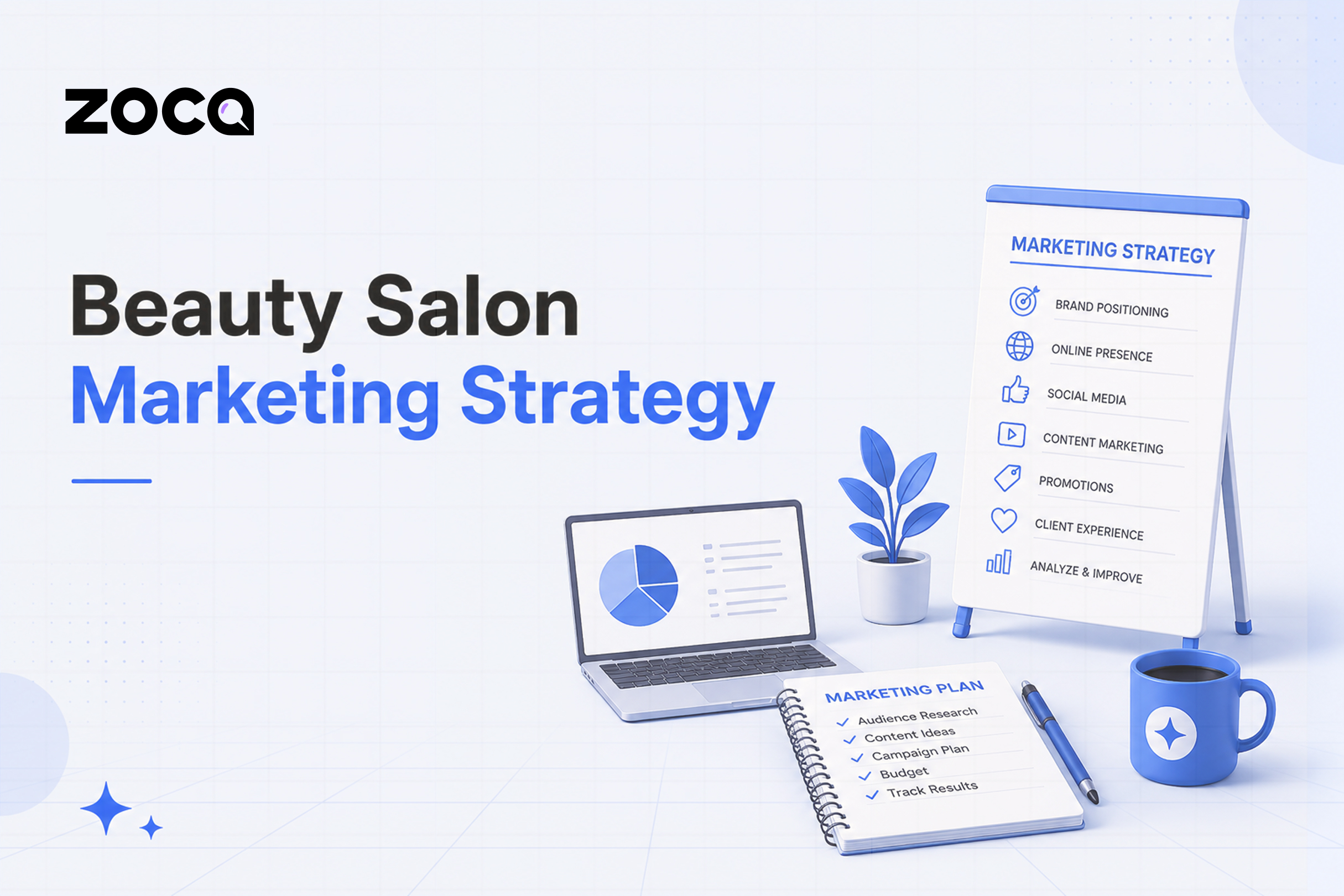
An effective beauty salon marketing strategy is not one tactic. It is a connected system that moves potential clients from awareness all the way through to loyal regulars.
Five things have to work together:
Visibility. People need to be able to find you. This means showing up in Google Maps results, in local search, in AI Overviews when someone asks for a recommendation, and through social media, where clients in your area are spending time. Visibility is not a one-time setup. It requires consistent attention to local SEO, Google Business Profile management, and content that signals relevance to search engines.
Trust. Being visible is not enough if people do not trust what they see. Reviews are the most important trust signal in the beauty industry. Potential clients read them before booking. Google uses them to rank local businesses. A consistent review generation strategy is not optional. It is foundational.
Inquiry conversion. This is where most salons lose the most ground. Someone finds your salon, they are interested, and they reach out. What happens next determines whether they become a client or walk away. Instant, helpful responses to calls, texts, website chat messages, and social DMs are now expected. After-hours inquiries, which represent a substantial portion of booking intent, require a system that can respond and capture that appointment even when your front desk is closed.
Booking convenience. If someone decides they want to book and they cannot do it easily, you lose them. Online booking, clear service menus, simple scheduling, and a payment process that does not create friction are all part of making the booking experience work for modern clients.
Retention. Getting a new client through the door costs more than keeping an existing one. Salons that grow consistently are not just good at acquiring clients. They are excellent at bringing them back. Rebooking reminders, follow-up messages, personalized outreach, and loyalty campaigns all contribute to this.
Google's own guidance for local business success emphasizes accuracy, completeness, and responsiveness as the key factors that influence local search performance. When your Google Business Profile is accurate, your information is complete, your reviews are fresh, and clients can easily contact you or book directly, your visibility improves.
These principles apply directly to salon marketing. A strong strategy treats all five of these areas as connected, not separate.
The Best Marketing Strategies for Beauty Salons
Local SEO: Getting Found Before the Competition
Local SEO for beauty salons means optimizing your online presence so that your salon appears when people in your area search for the services you offer. This is not just about your website. It includes your Google Business Profile, your citations on directories, the reviews you have, and the content you publish.
When someone searches "nail salon near me" or "best hair colorist in [city]," Google is doing an assessment of every salon in that area to decide which ones to show. It is looking at relevance (does this business offer what the person searched for?), distance, and prominence (how well-known and trusted is this business based on reviews, links, and online mentions?).
Improving your local SEO rankings requires attention to all three. Salons that rank consistently have fully optimized Google Business Profiles, a steady flow of recent reviews, accurate and consistent business information across the web, and content on their website that answers the specific questions potential clients are searching for.
For a detailed breakdown of ranking strategies, the Zoca guide to ranking higher on Google Maps for salons covers ten specific approaches that produce results.
Google Business Profile Optimization
Your Google Business Profile is often the first impression a potential client has of your salon. It appears in Maps results, in local packs, and in the knowledge panel when someone searches your business name directly. Getting it right matters.
A well-optimized profile includes your full business name, accurate address and phone number, up-to-date hours including holiday hours, a complete and specific list of services with descriptions, a strong mix of photos showing your work, your interior, and your team, and a recent collection of reviews.
Many salons have profiles that are technically live but effectively broken. The address might be slightly off. The hours were never updated after a schedule change. The category is too broad. There are three photos from 2022. These issues quietly suppress your visibility every day.
If your Google Business Profile is not generating calls and bookings, the Zoca guide to fixing your GBP for salons is a practical starting point. You can also run a quick analysis using the Zoca free GBP strategy tool to identify specific gaps.
Review Generation: Building Trust at Scale
Asking for reviews feels awkward, which is why most salons do it inconsistently, or not at all. But reviews are too important to leave to chance.
The most effective approach is systematic. After every appointment, send a follow-up message thanking the client and making it simple to leave a review with a direct link. Timing matters. A message that arrives within an hour or two of the appointment, while the experience is still fresh, converts significantly better than a general "please review us" request sent days later.
Responding to every review, positive and critical, signals to both Google and potential clients that your business is active and attentive. A short, genuine response to a five-star review takes thirty seconds. Ignoring reviews sends a message you probably do not intend.
Referral Marketing: Turning Happy Clients Into Growth
Word of mouth has always been powerful in the beauty industry. A structured referral program turns that organic dynamic into a repeatable system.
The most effective referral programs are simple, immediately rewarding, and easy to share. Offering a meaningful credit toward a future service when a referred friend books their first appointment gives existing clients a real incentive to send people your way, and gives the new client a reason to choose you over a competitor.
Referral programs work best when they are easy to explain and easy to redeem. Complex terms or delayed rewards reduce participation.
Social Media Strategy: Visibility Without the Algorithm Dependency
Social media is a visibility tool for beauty salons, not a booking engine on its own. The goal of your social presence should be to build familiarity and trust with people who are already in your local area, not to go viral.
For most salons, Instagram and TikTok are the most relevant platforms. Before-and-after transformations, behind-the-scenes content, quick tutorials, and client spotlights all perform well. Short-form video tends to reach new audiences more effectively than static posts.
The key discipline is consistency over volume. Posting thoughtfully three times a week produces better results than a burst of twenty posts followed by silence. Your content should reflect the actual work you do, the clients you serve, and the experience of being in your salon.
Social media also supports your Google visibility indirectly. When people see your work online and then search for you, a strong Google Business Profile converts that interest into a booking.
AI-Powered Inquiry Handling: Capturing Bookings You Would Otherwise Lose
This is one of the most significant shifts in how modern salons operate, and it is one of the least discussed.
Most salons field inquiries through multiple channels: phone calls, SMS, website chat, Instagram DMs, Facebook messages, and sometimes email. Each of these represents a potential booking. The challenge is that inquiries do not arrive only during business hours, and no front desk team can monitor every channel simultaneously.
The result is a predictable pattern: a potential client reaches out after 7 pm, nobody responds until the next morning, and by then they have booked with someone else. A missed call that goes to a generic voicemail rarely gets returned as a booking.
An AI Front Desk Agent solves this by handling inquiries across every channel instantly, around the clock. When someone calls, and the line is busy, it follows up. When a text comes in at 9 pm asking about availability for a color appointment, it responds immediately, asks the right questions, and captures the booking before that intent is lost.
This is not about automating away the human experience of a salon. It is about ensuring no inquiry goes unanswered. The booking happens, and your team picks it up in the morning, fully scheduled.
For salons specifically, this matters most for missed calls, after-hours texts, and the volume of incoming questions that come in on busy days when the phone is ringing while stylists are mid-service.
Retention Campaigns: Keeping Clients Who Already Love You
Client retention is the most cost-effective growth lever available to a salon. A client who books every six weeks is worth dramatically more than two clients who each visit once. The difference between a salon that grows steadily and one that churns through clients is usually found in how deliberately they manage the post-visit experience.
Proven client retention strategies for salons include rebooking reminders sent at the right interval based on service type, personalized follow-ups that reference the specific service the client received, win-back campaigns targeting clients who have not returned in 90 or 180 days, and loyalty programs that reward frequency.
The timing of a rebooking reminder is important. For a haircut client, the right window is around four to five weeks post-appointment. For a color client, it might be eight to ten weeks. A generic "we miss you" message sent without regard for when the client actually needs to return will underperform compared to a message that arrives right when the client is starting to think about their next appointment anyway.
Retaining salon clients without discounts is possible when your communication is timely, personal, and genuinely helpful. Discounts are one tool, but they are far from the only one.
SMS Marketing: The Most Direct Channel You Have
Text messaging is the highest-engagement channel in a salon's marketing toolkit. Open rates for SMS messages consistently outperform email by a significant margin. For appointment reminders, booking confirmations, rebooking nudges, and time-sensitive promotions, SMS is the most effective delivery method.
Salon SMS marketing works best when messages are brief, specific, and sent at the right moment. A text that says "Hi [name], your color appointment is due in about 2 weeks. Reply to book your spot" is simple, useful, and easy to respond to.
Building your SMS list requires client consent, which is typically captured at booking. Keeping the list engaged means not over-sending and making sure every message has a reason for being there.
Seasonal Promotions: Filling Gaps Without Training Clients to Wait for Deals
Seasonal promotions are a legitimate tool in a beauty salon marketing strategy. They create natural urgency around specific time periods (holiday season, back to school, summer), introduce clients to services they have not tried, and fill calendar gaps during historically slower weeks.
The discipline is in how they are framed. A promotion that positions a service experience, such as a holiday glam package or a new year treatment, preserves the perceived value of your work more effectively than a percentage off discount applied to existing services.
Promotions should be the exception rather than the calendar. Running one every two or three weeks trains clients to expect deals, which erodes your pricing authority over time.
Content Marketing: Building Authority and Organic Visibility
Publishing useful, well-optimized content on your salon's website builds long-term organic traffic and topical authority. Blog posts, service pages, and FAQ content that answers the questions your potential clients are actually searching for create discovery opportunities that social media posts cannot.
Topics that work well for beauty salon blogs include service guides (what to expect during a keratin treatment, how to maintain balayage at home), comparison content (different types of hair extensions, lash lift vs. lash extensions), local guides (the best salons in [city] for wedding hair), and how-to content for at-home maintenance between appointments.
This type of content, when well-written and properly optimized, can rank on Google for months or years, delivering consistent visibility without ongoing ad spend.
Why Google Visibility Is Now the Frontline of Beauty Salon Marketing
The way clients discover salons has shifted fundamentally. It is not that Google became more important. It is that the way Google works has changed, and the shift is significant enough that many salon marketing strategies built three or five years ago are now quietly underperforming.
Here is what is happening: when someone opens Google and types "best hair salon for curly hair near me," they are no longer just getting a list of links. They are getting an AI-generated overview at the top of the page that summarizes the best options, pulls from reviews, and often includes a direct recommendation. That AI Overview is populated with information from Google Maps, business profiles, and review data. If your salon is not feeding that system with accurate, complete, and trusted signals, you will not appear in those results, even if your actual work is excellent.
Beyond Google, people are also asking ChatGPT and Gemini for local business recommendations. These AI tools pull from publicly available information, review platforms, and indexed web content to generate their answers. A salon that has no substantial online presence, few reviews, and minimal published content is essentially invisible to these systems.
For local discovery, the future of local SEO in 2026 is increasingly about being cited by AI systems, not just ranked by traditional algorithms.
Conversational search is also growing. People now search the way they talk. Instead of typing "nail salon Brooklyn," they ask, "where should I get my nails done near Williamsburg?" These longer, more specific queries favor salons that have rich, descriptive content about their services and location.
What this means practically: your Google Business Profile is not a nice-to-have. It is the foundation of your discoverability. Your reviews are not just social proof for potential clients. They are signals that AI systems use to evaluate your credibility. Your website content is not just for human visitors. It is being read and indexed by language models that decide whether to recommend you.
The salons that will dominate local discovery in the years ahead are the ones that treat their Google presence, their review strategy, and their online content as an interconnected visibility system rather than separate boxes to check.
How AI Is Changing Beauty Salon Marketing
The conversation about AI in the salon industry often focuses on the wrong things. It gravitates toward AI-generated images or chatbot gimmicks rather than the genuinely useful applications that are quietly improving how real salons operate.
The most practical application of AI for salons right now is in how inquiries are handled and how operational gaps are closed.
AI search is reshaping discovery.
As noted above, Google AI Overviews, ChatGPT, and Gemini are now part of the client discovery journey. Salons that publish useful content, maintain accurate profiles, and have strong review signals are more likely to be cited by these systems.
AI front desk tools are closing the response gap.
The most common point of failure in salon marketing is not visibility. It is what happens after a potential client reaches out. An AI receptionist for salons handles this by providing instant responses across every channel, qualifying inquiries, confirming appointment details, and capturing bookings even when the physical front desk is not available.
This matters for after-hours inquiries, which represent a substantial and often uncaptured portion of booking intent. It also matters during peak hours when the phone is ringing while stylists are with clients. Every unanswered call is a potential booking that walked out the door.
Automated follow-ups drive retention.
AI-powered retention tools send the right message to the right client at the right time. Rather than manually tracking who is due for a color appointment or who has not been in for three months, the system identifies those clients and triggers personalized outreach automatically. This is the operational reality behind a loyalty program that actually works at scale.
Booking automation removes friction.
Connecting AI inquiry handling directly to a booking system means the path from "I want to book" to "I am confirmed" happens in a single conversation, without requiring a phone call during business hours or a human to check availability.
None of this replaces the skill, the relationship, or the experience that defines a great salon. It removes the operational gaps that prevent those things from translating into consistent business growth.
Why Retention Matters More Than Constant Promotions
The most profitable salons are not the ones that are best at finding new clients. They are the ones that are best at keeping the clients they already have.
Here is the math that makes this clear. If a client comes in for a color service every eight weeks, their annual spend might be around $800 to $1,200, depending on your pricing. If you retain that client for three years, they represent $2,400 to $3,600 in revenue, not counting referrals, retail purchases, or service additions.
Now consider that acquiring a new client costs meaningful resources: advertising, promotions, the time of staff explaining your menu for the first time, and the risk that the first visit is not perfect. A retained client has already moved past all of those costs.
Client lifetime value is the metric that separates salons that grow steadily from those that feel like they are always starting over.
The mechanics of strong retention are straightforward, even if the execution takes consistency:
Rebooking before they leave.
The single highest-conversion moment for the next appointment is when the client is still in your chair. A stylist who offers to hold a spot for the client's next appointment eight weeks out converts at a much higher rate than a reminder text sent four weeks later.
Timely follow-up.
A thank-you message after the first appointment, a check-in a few days later for color clients asking how they like the results, and a rebooking prompt at the right interval all contribute to retention without feeling pushy.
Win-back campaigns for lapsed clients.
Clients drift away for dozens of reasons that have nothing to do with their experience at your salon. Life gets busy. They moved. They tried someone closer. A well-timed win-back message, perhaps with a relevant service offer or a "we'd love to see you again" note, can recover a significant percentage of clients who went quiet.
Zoca's Loyalty Agent automates this entire cycle. Rebooking reminders, follow-up sequences, and win-back campaigns run based on each client's individual service history and visit patterns, not on a generic calendar. The result is a retention system that works without requiring a team member to manually track every client relationship.
What Most Beauty Salons Get Wrong About Marketing
This section is worth being direct about because the same patterns repeat across the industry.
Treating content creation as the whole strategy.
Posting consistently on social media is a piece of the puzzle. But it is one piece. A salon can have a beautiful, well-followed Instagram account and still struggle to fill its calendar if local SEO is broken, reviews are thin, the booking experience is clunky, and inquiries go unanswered for hours.
Ignoring what happens after the discovery.
Salon marketing conversations focus heavily on getting found. That focus is warranted, but it creates a blind spot. The conversion rate between "someone found you" and "someone booked with you" is where enormous amounts of revenue are quietly lost. Fixing the discovery problem without fixing the response and booking experience is like fixing a leaky roof while the foundation is cracking.
No system for inquiry capture.
If you asked most salon owners how many inquiries they receive that never convert, they would not be able to answer. Missed calls, unanswered DMs, and contact form submissions that get forgotten are invisible losses. Building a system that captures every inquiry, whether through an AI front desk tool, a dedicated booking link on every channel, or structured follow-up protocols, is one of the highest-ROI improvements a salon can make.
Running promotions without a retention strategy.
Promotions bring people in. But if there is no system to bring them back, every promotion is essentially buying a single visit at a discount. The return on that investment is low. Pairing any acquisition campaign with a retention system, even a simple rebooking prompt and follow-up sequence, changes the economics dramatically.
Inconsistent communication.
Clients expect to be communicated with in the way they initiated contact. Someone who texts you should get a text back. Someone who DMs on Instagram should hear back through Instagram. Many salons have a single communication channel they monitor well, and several others that fall through the cracks. Consolidating inquiry management, or using a tool that handles this across channels, prevents the inconsistency that erodes trust.
Not knowing their numbers.
How many new clients did you acquire last month? What percentage returned for a second appointment? What is your average visit frequency? These questions are basic, and the answers drive every marketing decision. Without tracking them, you are optimizing by feeling rather than by data.
How Zoca Helps Beauty Salons Grow
Zoca is an AI growth platform built specifically for salons, spas, wellness studios, and multi-location beauty businesses. It is designed to connect the pieces of salon growth that typically live in separate tools, or do not exist at all.
The platform works across three connected systems:
Discovery Agent. The Discovery Agent handles local SEO, Google Business Profile optimization, content visibility, and local search rankings. The goal is simple: make sure more of the right people find your salon when they are actively looking for your services. This connects to your keyword visibility strategy and ensures your online presence is working consistently, not just on the days you remember to update it.
AI Front Desk Agent. The AI Front Desk Agent is the core of the platform. It handles incoming calls, texts, website inquiries, social DMs, booking requests, appointment confirmations, reminders, and after-hours outreach. When a potential client reaches out, the AI Front Desk responds instantly, handles the conversation, and captures the booking. No inquiry goes unanswered. No after-hours text sits waiting until morning. No missed call becomes a lost client.
This is Zoca's central differentiator. Most salon software manages calendars. The AI Front Desk Agent manages conversations and converts them into bookings.
Loyalty Agent. The Loyalty Agent manages the client relationship after the appointment ends. It handles rebooking reminders, win-back campaigns for lapsed clients, personalized follow-up messages, and retention automation. It identifies which clients are due for their next service based on actual service history and triggers outreach at the right moment.
Together, these three systems handle the full growth cycle: getting discovered, capturing every booking opportunity, and keeping clients returning consistently.
For salon owners who are thinking about how to grow a salon business in 2026 and want a platform that connects all of these operational layers without requiring five different subscriptions, Zoca is built exactly for that.
If you are exploring specific strategies for different salon types, the guides on how to market a nail salon and how to get clients as a lash tech cover channel-specific approaches in detail.
Conclusion
The beauty salon industry has never been more competitive for attention, and the tools available to salon owners have never been more powerful.
A successful marketing strategy for a beauty salon in 2026 is not about doing one thing brilliantly. It is about connecting discovery, inquiry response, booking conversion, client communication, and retention into a coherent system that works whether you are standing at the front desk or in the middle of a color service.
Salons that are growing right now share a few things in common. They are visible in local search and Google Maps. Their inquiry response is fast and consistent. Their booking process is simple. And they have a deliberate system for bringing clients back, not through endless promotions, but through timely, relevant communication that makes clients feel remembered.
Zoca is built for exactly this kind of connected growth. The Discovery Agent improves visibility, the AI Front Desk Agent captures every inquiry and converts it into a booking, and the Loyalty Agent keeps clients returning through automated, personalized retention.
If you want to see how that works for your salon, book a free demo and walk through it together.
Frequently Asked Questions
What is the most effective marketing strategy for a beauty salon?
The most effective beauty salon marketing strategy combines local SEO, Google Business Profile optimization, consistent review generation, fast and reliable inquiry handling, and a structured client retention system. No single tactic works in isolation. Salons that grow consistently build these elements as a connected system rather than running individual campaigns.
How do I get more clients for my beauty salon?
Getting more clients requires two things: being discoverable and converting the people who find you. Improving your Google Maps visibility, generating fresh reviews, making it easy to book online, and ensuring every inquiry receives a fast response are the four highest-leverage actions most salons can take. See how Zoca's Discovery Agent helps with the visibility side.
How do beauty salons use Google Maps for marketing?
Google Maps is one of the primary discovery channels for local beauty services. To use it effectively, salons need a fully optimized and regularly updated Google Business Profile, a steady flow of recent reviews, accurate business information, and content that signals relevance to local service searches. Appearing in the top three of Google Maps results for your key services can dramatically increase inbound calls and bookings.
Why is my beauty salon not getting enough bookings?
The most common reasons are limited local visibility (not appearing in Google Maps or local search), slow response to inquiries, a booking process that creates friction, and no system for bringing past clients back. Most salons have a gap in at least two of these areas. Diagnosing which gap is largest is the first step.
How do I retain beauty salon clients?
Client retention in salons improves when you have a system for rebooking at the right interval, following up after appointments, and re-engaging clients who have gone quiet. The key is timing. The right message at the right moment, whether that is a rebooking reminder at four weeks or a win-back campaign at 90 days, outperforms generic loyalty communications. Zoca's Loyalty Agent automates this based on individual client history.
What is the best way to respond to beauty salon inquiries?
The best response is fast, consistent, and channel-appropriate. Clients who text expect a text back. Those who DM on Instagram expect a response there. The challenge is that inquiries often arrive outside business hours or when staff are with clients. An AI front desk system that handles multi-channel inquiries instantly is the most scalable solution to this problem.
Do beauty salons need to be on social media?
Social media is a useful visibility channel, particularly for showcasing work and building local familiarity, but it should not be the foundation of a salon's growth strategy. The algorithm controls your reach, and organic social discovery for local services is unreliable. A strong Google presence combined with a social media presence produces better results than social media alone.
How does AI help beauty salon marketing?
AI supports salon marketing in three main ways: it improves discoverability through better local SEO and content optimization, it handles inquiry capture and booking across channels around the clock, and it automates client retention through timely, personalized outreach. These applications address the most common operational gaps that prevent salon growth.
What is local SEO for beauty salons?
Local SEO for beauty salons is the practice of optimizing your online presence so that your salon appears in local search results when nearby clients search for your services. It includes Google Business Profile management, review generation, consistent business citations across the web, website optimization for location-based keywords, and content that answers the specific questions salon clients are searching for. Learn more about improving your local SEO.
How do I reduce no-shows at my beauty salon?
Reducing no-shows requires a combination of appointment confirmation messages, reminder texts sent 24 to 48 hours before the appointment, and a clear cancellation policy communicated at booking. Automated reminder systems consistently reduce no-show rates. Zoca's no-show reduction guide covers specific approaches that work.