

Key Takeaways
- Building clientele is a learnable skill, not luck. The right system gets you there.
- Knowing your ideal client makes every marketing effort more effective.
- Your Google Business Profile is the most powerful free tool to get discovered locally.
- A simple referral program turns happy clients into a steady source of new bookings.
- Retaining an existing client costs far less than finding a new one.
- Personalizing every client experience builds loyalty that no competitor can easily take away.
- Every new certification you earn opens a new client audience you are not currently reaching.
You can be the most skilled esthetician in your city and still have a half-empty schedule. Talent gets you licensed. It does not get you clients.
What fills a book is a system: being findable, being memorable, and making it easy for clients to keep coming back. Most estheticians have none of these working together. The ones who do are the ones with waitlists.
This guide builds that system for you, step by step. And unlike most guides on this topic, it is built on what we have seen actually work across more than 1,000 beauty and wellness businesses, not just general marketing advice repackaged for estheticians.
Why building clientele is the #1 challenge for estheticians
Most estheticians graduate knowing exactly how to deliver a great facial. Almost none of them graduate knowing how to build a business around it.
That is not a dig at esthetics education. It is just the reality of what the curriculum covers and what it does not. Marketing, local visibility, client retention, referrals, none of it is in the syllabus. And by the time most estheticians realize that skill alone does not fill a book, they are already six months into a slow start, wondering what they are doing wrong.
Nothing is wrong. The playbook was just not handed to you. This guide is that playbook.
What we see consistently working: Diamond Aesthetics was exactly in this position. Spending heavily on Google and Instagram ads, burning budget, getting leads that would not convert, and managing everything solo with no clear picture of what was working. Once they stopped guessing and put the right system in place, the result was consistent monthly leads, higher-quality clients, and marketing that no longer depended on ad spend to survive. The strategies behind that shift are what this guide covers and at the end, we will show you how Diamond Aesthetics got there so you can replicate it.
What we have learned from 1,000+ esthetics businesses
Before diving into tactics, here is what the data actually shows. These are patterns from working with over 1,000 beauty and wellness businesses, not marketing theory.
The retention gap is the real problem - Most estheticians who come to us think their problem is not getting enough new clients. In almost every case, the real problem is losing the clients they already have. A business losing 30% of its clients every quarter needs to replace 120 clients a year just to stay flat. Fix retention first, and acquisition becomes far less urgent.
Google is still the highest-converting channel - Despite all the noise around social media, clients who find you through Google are already looking for exactly what you offer. Across the businesses we work with, Google consistently drives higher-quality booking intent than social media. The client is actively searching, not passively scrolling. Social builds awareness. Google captures intent. Both matter, but they are not equal.
The estheticians who fill their books fastest are known for one thing - Not ten things. One. Whether it is acne, anti-aging, or hyperpigmentation, specificity attracts faster than breadth. Generalists compete on price. Specialists compete on expertise.
Review velocity matters more than review volume - A profile with 20 reviews posted over the last 3 months outperforms a profile with 200 reviews where the last one was posted 18 months ago. Recency is a major ranking signal that most estheticians do not understand.
Keep these patterns in mind as you read through the strategies below. They will help you prioritize which ones to implement first.
1. Identify your ideal client before marketing anything
Before you market anything, you need to know exactly who you are trying to reach. Knowing your ideal clients, their pain points, and demographics is a must. Most estheticians skip this step and end up targeting a broad audience that doesn’t resonate with anyone.
Start by asking yourself:
- What skin concerns am I specialized in? Acne, hyperpigmentation, aging, sensitivity?
- Who is already booking with me and getting the best results?
- What age group, lifestyle, or skin type do I understand best?
- What problems do my clients come in with that they have not been able to solve elsewhere?
Your answers point directly to your ideal client. If you are unsure what your local market is actually searching for, Zoca's Local Business Demand Tracker shows you the exact keywords people in your area are searching for, so you can align your speciality with real demand rather than guessing.
Niche down, then market with confidence
Estheticians with the longest waitlists are almost always known for something specific. Claiming a speciality does not limit your business. It makes you the obvious choice for a defined group of people instead of one option among many.
When someone searches "esthetician for sensitive skin in Los Angeles," you want your name to show up. That only happens if your positioning, your website, and your Google Business Profile all reflect a clear speciality.
Describe what clients get, not what you do
Clients are not booking a facial. They are booking clearer skin, more confidence, or a solution to something that has bothered them for years.
"Hydrating facial" tells them nothing about why they should choose you. "A 60-minute treatment that rebuilds your skin barrier and keeps skin glowing for two weeks" gives them a reason to book. Apply that outcome-first framing to your website, Google profile description, Instagram captions, and how you talk about your services in the room.
2. Optimize your Google Business Profile (GBP)
When someone searches "esthetician near me," Google shows the three most relevant, trusted local businesses. If your business is not one of them, that client will book someone else. Your GBP is your highest-leverage free tool, and most estheticians set it up once and treat it as done.

An optimised GBP profile needs:
- Full service list with descriptions and prices where possible
- Accurate working hours, updated for holidays
- Real photos of your space, products, and before/after results
- Authentic, steady stream of Google reviews
- A business description that includes your speciality and city name
- Regular posts at minimum once a week to signal an active, relevant business
Google rewards active, complete profiles with better placement in local search. Most estheticians underestimate how much work a fully complete GBP can do before a single dollar is spent on ads.
If you want to know exactly where your profile stands right now, Zoca's Google Business Profile Optimizer audits your profile and shows you the specific fixes that will improve your local ranking. Most estheticians who run the audit find three or four high-impact gaps they had no idea existed.
3. Show up on Google with local SEO
Local SEO is what gets your website and profile to appear when people nearby search for your services. Most estheticians skip it entirely, which is exactly what makes it an opportunity.
Three things that move the needle most:
- Your name, address, and phone number (NAP) are identical across every platform
- Your website has a dedicated page for each key service, using specific search terms clients use
- Your Google profile stays active with new photos, posts, and reviews coming in regularly
The estheticians who show up consistently in local search are not doing anything complicated. Improving your local SEO rankings comes down to three factors: prominence, relevance, and proximity. These can be achieved by using the same business information everywhere, adding location-specific language on your website, and a well-optimized Google profile that stays active with new photos, posts, and reviews.

4. Post on Instagram or TikTok to build trust before someone books
You do not need to go viral. You need to be consistent enough that when a potential client finds your page, they spend a few minutes on it and leave wanting to book.
What actually works to post:
- Before-and-after photos with a clear description of the concern treated and treatment used
- Short skin tip videos that demonstrate your expertise without giving away the whole protocol
- Behind-the-scenes treatment content that gives clients an overview of the procedure
- Posts that show your personality, not just your work because clients book professionals they trust
Post three to four times a week. Use your city name in your bio and captions so you show up for local searches. And treat social media as a trust-building tool, not a direct sales channel. The estheticians who get the best results from social are the ones who educate and entertain first, and sell second.
5. Turn happy clients into a referral engine
Word of mouth happens accidentally. A referral system makes it happen consistently. McKinsey research shows that 20 to 50% of all buying decisions are influenced by word of mouth. The estheticians who tap into this deliberately build their clientele significantly faster.
Create a referral program that is simple to explain and easy to use
The simpler the offer, the more clients will actually share it.
Example: "Refer a friend and get $20 off your next service. No limit on referrals."
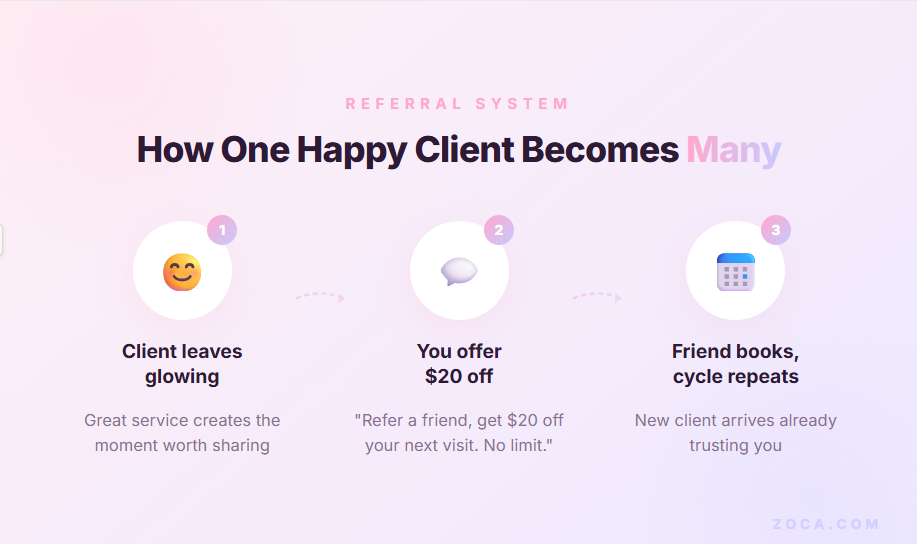
Mention it in three places: your post-appointment follow-up message, your booking confirmation, and in conversation at the end of a service when the client is happy and relaxed. The timing of that last mention matters. A client who just had a great experience is far more likely to share than a client who receives a generic text three days later.
Ask for Google reviews right after the service
Most estheticians either never ask for reviews or ask at the wrong time. Clients who are asked to review immediately after a service, while they are still in that post-facial glow, are far more likely to leave one than clients followed up days later. Getting more Google reviews consistently is less about how you ask and more about when. Make it easy for them by using a QR code they can scan and review in two simple steps, or send a direct link in your follow-up text so it takes one tap.
As mentioned earlier, review recency matters more than volume. Make review collection a consistent habit, not a one-time push, and the timing of when you ask makes all the difference.
Partner with local businesses
Hair salons, nail techs, brow artists, massage therapists, and personal trainers all serve overlapping audiences. Two or three reciprocal referral partnerships cost nothing and can generate a consistent stream of prospects within weeks.
6. Use promotions to open doors, not fill empty slots
Running discounts whenever bookings are slow trains clients to wait for deals and quietly erodes the value of your work. There is a better way to use promotions strategically.
Introductory offers for first-time clients
A discounted first service removes hesitation for someone who does not know you yet. Once they experience your work, the price barrier disappears. Set a clear end date so the offer creates urgency. Apply it to a service that shows your best work, not your cheapest one.
Seasonal promotions tied to real skin needs
A winter hydration treatment, a pre-summer brightening facial, or a post-holiday skin reset land better than "20% off this month" because they feel like a recommendation, not a clearance sale. Frame it as advice: "This is the best time of year to focus on hydration before the cold really sets in. I have a few spots open if you want to get ahead of it." Estheticians who frame seasonal offers as expert advice rather than discounts consistently see higher uptake than those running flat percentage-off promotions.
Memberships and loyalty programs
Clients who prepay show up, rebook, and rarely go elsewhere because they already have credit with you. According to McKinsey's research, members are 43% more likely to book weekly after joining a loyalty program, 59% more likely to choose that provider over a competitor, and 62% more likely to spend more money with that provider.
A three-facial bundle at a slight discount or a monthly membership with one treatment and a retail credit converts occasional visitors into regulars before they have even decided to be one.
7. Keep every client you work hard to get
Getting a new client costs six to seven times more than keeping an existing one. Most estheticians spend the majority of their energy on acquisition and then wonder why their book never feels stable. Client retention is where the real growth compounds.
Pre-book the next appointment before the client leaves
This is the single most effective retention habit in esthetics, and the most consistently skipped. Before a client leaves, book their next appointment. Do not present it as optional. Frame it as the logical next step.
What to say: "To keep your skin progressing the way it has been, I recommend coming back in six weeks. I have a Tuesday at 2 pm and a Thursday at 11 am open right now. Which works better for you?"
Clients who leave without rebooking are the clients who disappear. This one habit, done consistently, changes your retention rate within 90 days.
Keep detailed client notes and personalize their experience
After every appointment, spend two minutes updating your client record. Their skin concerns, what treatments they responded well to, products they mentioned trying at home, and anything personal they shared in conversation.
Those notes are what make the next visit feel different from a generic service. When you ask, "how has your skin been since we switched your cleanser?" or remember they had a big event coming up, the client feels genuinely known. That is not a small thing. According to McKinsey, 71% of consumers expect personalization, and businesses that deliver it generate 40% more revenue than those that do not.
In practice, personalization for estheticians means three things:
- Customizing every treatment based on what you know about their skin, not just what they tell you on the day
- Sending follow-up messages that reference their specific concerns, not a generic "hope you enjoyed your visit"
- Recommending customized skin care products and regimens based on their actual routine and skin goals, not a standard protocol
Clients who feel like you truly understand their concern do not shop around. They rebook, they refer, and they stay loyal even when a cheaper option opens up down the street.
Follow up three to five days after every appointment
Send a short message asking how their skin is feeling. Nothing more.
Example: Hey Sarah, just checking in. How has your skin been feeling since your facial on Tuesday?
No upsell, no review request. Just genuine follow-through. Most estheticians never do this. Those who consistently show up in referrals and five-star reviews as someone who genuinely cares.
Send a monthly email to stay top of mind
Social media algorithms decide who sees your posts. Email does not have that problem. One monthly email with a skin tip, a seasonal recommendation, and a booking link keeps you in your clients' heads between visits without competing for attention in a crowded feed.
Pre-booking, follow-ups, and email all work better as a connected system than as isolated habits. Running them manually on a full client schedule is where most estheticians drop the ball. That is the gap Zoca's Loyalty Agent was built to close by automating the rebooking reminders, post-appointment follow-ups, and review collection so they run consistently in the background without requiring your attention.
8. Add new services to attract new clients
Every new certification you earn creates a new group of people searching specifically for that treatment. This is one of the most overlooked client acquisition strategies in esthetics.
Add treatments that consistently attract new search traffic, such as LED therapy and light treatments, chemical peels, microneedling, etc. Each of these has its own search audience specifically looking for that service, not just "esthetician near me."
The smartest way to launch a new service is to market it to your existing clients first. They become your first bookings. Their results and reviews then bring in new clients who found you specifically because you offer that treatment. You build social proof before you build the new audience. Across the businesses we work with, services launched to existing clients first typically reach full bookings before any external promotion even goes live.
How Zoca helps estheticians stay fully booked
Working with over 1,000 beauty and wellness businesses, what we see consistently is that the strategies in this guide work. The challenge is executing all of them manually on top of a full client schedule, which is why most estheticians implement one or two and let the rest slip.
The estheticians who go from half-booked to waitlisted are not the ones working harder. They are the ones who stopped doing everything manually.
Circling back to Diamond Aesthetics, they were running ads, managing their Google profile inconsistently, and following up with clients only when they remembered to. Once Zoca's system took over local visibility, automated post-appointment follow-ups, and made review collection happen at the right moment every time, the result was consistent monthly leads without touching the ad budget, lower CAC, and a retention rate that compounded month over month.
That is what a system does. Not one of these strategies in isolation, but all of them working together without requiring your daily attention.
Zoca's Discovery Agent handles local visibility so clients find you first. The AI Front Desk Agent turns every inquiry into a confirmed appointment. The Loyalty Agent automates rebooking reminders, post-appointment follow-ups, and review collection. Your only job is to show up and do great work.
Ready to see all three in action? Book a demo and see exactly how Zoca builds your clientele on autopilot.
Frequently Asked Questions
How long does it take to build a clientele as an esthetician?
Most estheticians build a stable, full schedule within 6 to 12 months when applying visibility, referral, and retention strategies consistently. Estheticians who prioritize retention early get there faster, keeping existing clients costs far less than replacing lost ones.
How many regular clients does a full-time esthetician need?
A full-time esthetician typically needs 80 to 120 active clients for stable income. The exact number depends on your pricing and how often clients return, higher-ticket monthly services require fewer total clients than lower-priced treatments.
What is the most effective way to retain esthetician clients?
Pre-booking the next appointment before the client leaves is the single most impactful habit. Combine it with a follow-up message three to five days after each visit and detailed client notes to personalize every appointment.
Should estheticians offer discounts to attract new clients?
A structured introductory offer for first-time clients works well. The risk is discounting reactively whenever the schedule is slow; it trains clients to wait for deals. Use first-time offers with clear expiry dates and focus on making the first experience good enough that they come back at full price.
Is social media necessary to build a clientele as an esthetician?
Not the only way, but the most accessible route to reaching clients who do not know you yet. Instagram and TikTok let you demonstrate expertise and build trust locally without ad spend. Treat it as a trust-building tool, not a sales channel.
What is the difference between esthetician marketing and general small business marketing?
Esthetician marketing is hyper-local and trust-dependent; clients are letting someone work on their face, so the bar is higher than most industries. Review recency, visible results, and demonstrated expertise carry more weight here than anywhere else.