


Introduction
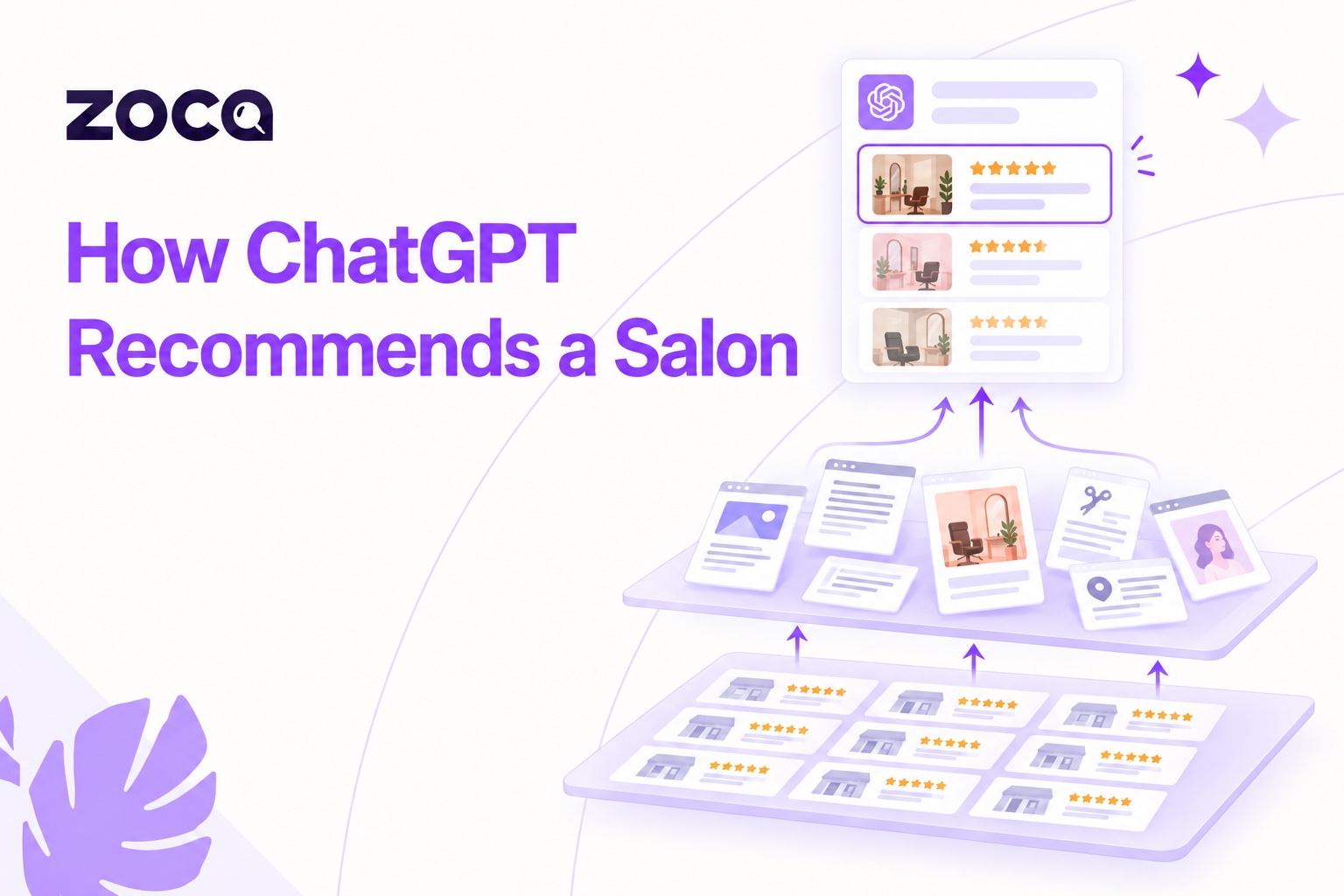
ChatGPT does not rank salons. When someone types "best nail salon in Phoenix," it rewrites that question into one or more search queries, sends them to a search partner, reads the pages that come back, and writes a shortlist with citations. That is OpenAI's own description of the mechanism (OpenAI Help Center). The shortlist is short. Across 350,000 locations belonging to 2,751 brands, ChatGPT recommended 1.2 percent of them, against 35.9 percent that appear in Google's local three pack (SOCi, January 2026). On September 11, 2026 I put fifteen beauty prompts to it across three cities and logged what it cited. It named 88 businesses. Fifty-four of them arrived with a star rating and a review count and no citation at all.
What happens in the seconds after she hits enter
OpenAI's help page is more candid than the agency guides written about it. ChatGPT "rewrites your query into one or more targeted queries that it sends those providers." The example given is a person in San Francisco asking for good restaurants near me, which becomes the search "top restaurants San Francisco." The only search provider named is Microsoft. Location is shared with "trusted third-party providers that help provide more local information, such as nearby business listings," and those providers are not named (OpenAI Help Center).
Read that as an owner. Your salon is not being evaluated. A search is being run, and whatever ranks for "best balayage salon Phoenix" on that partner is what gets read. Semrush measured about 15 cited sources per ChatGPT answer across 126 million US prompts from January to April 2026 (Semrush). The question is what is on those fifteen pages about you.
Fifteen prompts, three cities, one afternoon
Method: chatgpt.com on desktop, logged out, web search on, a fresh session for every prompt, no follow-ups. Five prompts in each of three cities I know from walking their salons, Phoenix, Dallas and Philadelphia: best hair salon for balayage, best nail salon, best barbershop for a skin fade, best med spa for Botox, and where should I get lash extensions. For each answer I recorded every business named and every citation chip attached. Fifteen prompts on one day is a field note, not a benchmark. The prompt-by-prompt log is in the sources for this piece.
| Prompt | Names across 3 cities | Names with a citation | What was cited |
|---|---|---|---|
| Hair salon for balayage | 16 | 6 | A local best-of list in every city, Fresha in two cities, one city magazine |
| Nail salon | 20 | 7 | Best Pros in Town in all three cities, Fresha, Birdeye, Philadelphia Magazine |
| Barbershop for a skin fade | 17 | 8 | A fade ranking site in every city, Birdeye, Booksy, two shops' own websites |
| Med spa for Botox | 16 | 8 | Med spa directories in every city, one review site, one injector registry |
| Lash extensions | 19 | 5 | Fresha, Birdeye, one studio's own website |
Twenty-one distinct sources were cited across the fifteen answers. Thirteen were curated lists or directories built for one vertical. Fresha appeared in four answers and Booksy in one, almost always for a price. Two city magazines were cited for awards. A business's own website was cited three times, each time for one fact: walk-in days, a price list, a line about specializing in fades.
Google, Yelp, Foursquare, Instagram and Facebook were cited zero times.
And yet 86 of the 88 names came with a star rating and a review count. "4.9 stars, 1,523 reviews." Those figures have the shape of Google review data. On all three barbershop prompts ChatGPT went further and rendered a place card: rating, category, open or closed right now, a street address, buttons for directions, website and call. Nothing in the answer said where the card came from.
Two layers: the names and the proof
Here is the mechanism as it looks from the outside. Two layers, behaving differently.
The first layer supplies the names. It is a business listings feed, the "nearby business listings" provider from OpenAI's page, and it arrives with a rating and a review count already attached. ChatGPT does not cite it. In my run, 54 of 88 businesses came from this layer alone.
The second layer supplies the proof. It is the set of pages the rewritten search returned, and those are what ChatGPT cites: a list somebody else wrote, a directory in your vertical, a marketplace page with your prices, your own site if it holds one fact worth quoting. When ChatGPT explains a top pick, it reaches into this layer. "A Phoenix salon guide also ranked them number one."
Whitespark's survey of 47 local search practitioners put the same picture in ranked form. The top factor for AI visibility was presence on expert-curated best-of lists. Second, a dedicated page for each service. Third, prominence on industry-relevant domains (Whitespark, November 2025). One surveyed expert scored Google Business Profile additional categories at zero for ChatGPT, because ChatGPT does not have that data. The fields an owner polished inside Google are not what this machine reads.
So the owner's question is not "how do I rank." It is two smaller questions. Am I in the feed with a rating a machine will repeat, and is there anything on the open web, written by someone who is not me, that agrees with the feed.
Does ChatGPT use Google Maps or Foursquare?
The published studies contradict each other.
Formative Digital scraped 1,732 citations from ChatGPT answers to "who are the best {vertical} in {city}" across nine Ontario cities and five service verticals in May 2026. Google.com was cited 130 times. The next most cited domain, a personal injury firm, appeared twice. Foursquare appeared zero times (Formative Digital).
Against that, a claim circulates that 60 to 70 percent of the business names inside a ChatGPT answer come from Foursquare. The page carrying it attributes the figure to two Spanish researchers reported secondhand in 2025 and publishes no sample size (Vyzz). I did not find the original measurement, so I am reporting the claim, not the number.
My fifteen prompts found google.com cited zero times, in a run where the data looked like Google's.
Three observations, three answers, because a citation is not a source. A citation is what ChatGPT shows you. A source is what it read. The feed that supplies names and review counts is invisible in every citation study, mine included, because ChatGPT does not footnote it. Formative saw google.com in the proof layer in Ontario. I did not see it in three US cities. Neither of us can see the names layer, and the Foursquare claim is about the names layer.
What an owner can act on is narrower. She cannot choose which feed ChatGPT licenses. She can make sure the feed and the open web agree about her. Same name, address, phone, hours and prices on Google, Bing, Apple, Yelp, the marketplace she is on, and her own site. When the machine reads a best-of list that says one thing and a marketplace page that says another, it has a reason to name someone else, and it has fourteen other pages open.
What the answer is worth, and how long it lasts
BrightLocal surveyed 1,002 US adults in early 2026. Forty-five percent had used an AI tool for a local business recommendation in the past year, up from 6 percent the year before. ChatGPT was the tool for 31 percent, Google's AI Mode for 23 percent (BrightLocal, March 2026). The same survey found 97 percent of AI users at least sometimes check the recommendation against real reviews.
So ChatGPT is the first door. The client then opens Google and looks at the profile. If the profile is thin there, being named got her nothing. The front door now has two rooms, and the second is the one I wrote about in the piece before this one, the profile that gets seen and passed over.
The answer also moves. A consultant in the Phoenix area asked Perplexity for the best med spa in four cities on August 4 and again on August 13, 2026, logged out. Eighteen practices were named the first time. Ten were gone nine days later (DigitallyYounge). One engine, two dates, but it is what the mechanism predicts. An answer built from this morning's search results gets built from different ones next week.
In the 3,709 customer calls we mined between December 2025 and July 2026, AI search went from zero mentions in the first months to something owners raised themselves by the end. It sat fifth on the list of what they brought up, behind reviews and Google rank, speed of reply, being locked into a booking platform, and missed calls. The owners who raised it had typed their own city into ChatGPT and not seen their name. That is the right test, and it costs nothing. It is why the Discovery Agent we built at Zoca starts by reading a business's listings the way a search partner would and reporting where they disagree, before anything is changed. The disagreement is the finding.
What to do this week, if you have one chair
None of this needs a budget. It needs an hour.
- Search your business name plus your city on Bing. Microsoft is the one search provider OpenAI names on its help page. If your Bing Places listing is missing or shows last year's hours, that is the first fix.
- Run the five prompts above for your own city, logged out, and write down every source ChatGPT cites. In my run, 13 of 21 were lists and directories. Most have a submission form, a claim button, or an editor with an email address. Those pages are the proof layer for your city.
- Give every service its own page on your site, with a price or a range. Own websites were cited three times in fifteen answers, each time for one quotable fact. Whitespark's experts ranked a dedicated service page second among AI visibility factors.
- If you are on a marketplace, keep the price list current. Fresha was cited in four of fifteen answers, almost always for what a service costs. If you are not on one, publish prices yourself so the machine does not need a marketplace to quote you.
- Med spas: a named, credentialed injector on your site and a claimed RealSelf profile. A Scottsdale test in July 2026 found ChatGPT's recommended med spas shared those, plus a published price where almost nobody publishes one (Loudmink).
Then leave it for a month and run the prompts again.
Where Zoca fits
Everything on that list can be done by one owner with an hour. What it cannot be done with is an hour every week, which is what the two layers above need, because the proof layer is rebuilt from that morning's search results every time somebody asks.
The feed and the proof layer. The Discovery Agent keeps the names layer and the proof layer agreeing about you: one name, address, phone, hours and price list across Google, Bing, Apple, Yelp and the marketplace you use, a page for each service with a price a machine can quote, and the local lists and directories in your city that ChatGPT actually cited. It reports what it submitted and what changed. It is a paid hire, and the assistants take weeks to reflect a change, so the honest timeline is signals by week four.
The baseline, before anything is paid for. The free Google Business Profile Optimizer reads the profile a client opens after ChatGPT names you, and the free website audit reads whether your site holds the one quotable fact per service that got other businesses cited. Run both before hiring anyone, including us.
The second room. ChatGPT is the first door and the profile is the second. The call that follows is the third. The Front Desk Agent answers it when it comes at 9pm, and the Engage Agent follows up with the person who opened the booking link and left.
Med spas. The credential and price work in point five is the part of the med spa job the Discovery Agent starts with, because it is what the Scottsdale test found the recommended practices had in common.
If you want to know where your listings disagree with each other before you fix anything, run the free Google Business Profile Optimizer and the free website audit. Both come back with the gaps, not a sales call. If you want the fifteen prompts run for your own city and read back to you, book a demo and name the city.
Questions owners ask
Does ChatGPT use Google reviews to recommend businesses?
It repeats numbers that look like Google's. In my fifteen prompts, 86 of 88 businesses were quoted with a star rating and a review count, and google.com was never cited. Formative Digital's Ontario study found google.com cited 130 times in 1,732 citations. The reading that fits both: a listings provider supplies names and ratings without a footnote, and Google pages appear as citations when the search partner returns them.
How do I get my salon recommended by ChatGPT?
Be the easiest salon in your city to verify. One consistent name, address, phone and hours across Google, Bing, Apple, Yelp and any marketplace you use, a page per service with a price, and a presence on the local best-of lists and directories ChatGPT cited when you ran your city's prompts. Whitespark's 47 experts ranked curated lists first and service pages second.
Do clients actually ask ChatGPT for a salon?
Forty-five percent of 1,002 US adults surveyed by BrightLocal in early 2026 had asked an AI tool for a local business recommendation in the past year, up from 6 percent a year earlier. Adults aged 30 to 44 led at 64 percent. Most then checked the recommendation against real reviews, so the profile they land on still has to hold.
Why was my salon in ChatGPT's answer last week and not this week?
Because the answer is assembled fresh from whatever pages a search returns that day, not pulled from a stored ranking. A Phoenix-area test on Perplexity found 10 of 18 named med spas gone nine days later. Add to the proof layer and check monthly instead of chasing the answer.