


Most salon and beauty business owners we talk to are frustrated with their conversion rates. They're running ads, posting consistently on social media, managing their Google Business Profile, and doing everything right from a marketing perspective. People are visiting their website, traffic is there, and clicks are happening.
But when it comes down to actual booked appointments, the numbers don't add up. There's a gap between the people who express interest and the people who actually schedule. And the confusing part is that you can't quite figure out where everyone's going.
If this sounds familiar, you're dealing with booking abandonment. But here's what makes it particularly difficult to solve: the problem isn't just that people are dropping off during the booking process. It's that you have no visibility into who these people are, where they're dropping off, or why they're leaving. Your marketing platform tells you someone clicked your booking link. Your scheduling software tells you they didn't book. What happened in between? That information simply isn’t visible to business owners.
This isn't a small oversight. It's a fundamental architectural problem with how marketing and booking platforms interact, or more accurately, how they don't interact at all. And it's costing salons thousands of dollars in lost revenue every month from warm leads that simply evaporate into thin air.
Read further to understand this issue better and find out the optimal solution.
Understanding Booking Abandonment
Booking abandonment occurs when a potential client initiates the appointment scheduling process but doesn't complete it. According to Baymard Institute, the average booking and cart abandonment rate across industries sits at 70.19%, meaning roughly 7 out of every 10 people who start the process never finish it. In the travel industry specifically, that number climbs to 81.7%.
The salon and beauty industry faces similar abandonment rates. When someone clicks "Book Now" on your website and gets redirected to your scheduling software (whether that's Vagaro, GlossGenius, Fresha, or any other platform), they're entering a multi-step process. They need to select a service, choose a date and time, provide personal information, and potentially enter payment details for a deposit. Each step introduces friction, and at any point, they can simply close their browser and walk away.
What differentiates booking abandonment from general website drop-off is the level of intent. Someone who abandons a booking isn't just a casual browser. They were interested enough to click through to your scheduling system and begin the process. They had purchase intent. They were ready to become a customer. Something in that booking flow stopped them.
Why This Matters More Than General Traffic Loss
When someone visits your Instagram and doesn't click through to your website, that's expected. Social media browsing is passive. People scroll, they look, they move on. Not everyone who sees your content will be in the market for salon or beauty services at that moment.
When someone visits your website and doesn't click the booking button, that's also somewhat expected. They might be researching, comparing options, or just checking your hours and location.
But when someone clicks your booking link and enters your scheduling system? That's different. They've made a decision to move forward. They've taken action. They're not just browsing anymore - they're actively trying to book with you.
That's why booking abandonment is so costly. You've already paid to acquire these prospects through your marketing. You've already convinced them to take action. They're warm leads, not cold traffic. When they drop off at this stage, you're not just losing a potential client - you're losing someone who was about 70-80% of the way to becoming an actual client.
According to Harvard Business Review, it costs 5 to 25 times more to acquire a new client than to retain an existing one. So losing someone at the booking stage, after you've already spent the money to bring them there, is the most expensive drop-off in your entire funnel.
The Data Gap Between Marketing and Booking Systems
Here's where the real problem arises, and it's technical in nature.
Most salons use two separate systems: one for marketing and one for booking. Your marketing might run through Zoca, while your appointments might be managed through Vagaro. Or you might use Google Ads to drive traffic, which then gets sent to a Fresha booking page. The specifics don't matter - the architecture is the same. Marketing happens in one place, booking happens in another.
These systems don't communicate with each other.
What Your Marketing Platform Can See
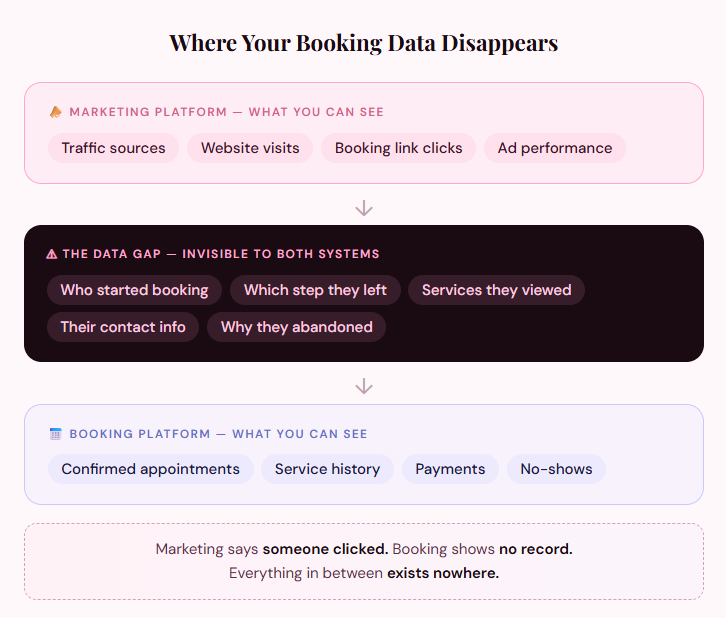
Your marketing platform tracks everything up to the point where someone leaves your website. If you're using Zoca, Google Analytics, or any modern marketing tool, you can see:
- How many people visited your website
- Which pages they looked at
- How long they stayed
- Whether they clicked your booking link
- Which traffic source they came from (Instagram, Google, Facebook ads, etc.)
This is valuable information. It tells you that your marketing is working. People are finding you, engaging with your content, and taking the first step toward booking.
What Your Booking Platform Can See
Your booking software tracks everything that happens after someone completes an appointment. Mindbody, Vagaro, Fresha, and similar platforms show you:
- Confirmed appointments
- Client service history
- Payment transactions
- No-shows and cancellations
- Rebooking patterns
This is also valuable information. It tells you how well you're retaining clients, which services are popular, and where you might have operational issues.
The Invisible Middle
What neither system can tell you is what happens in between.
When someone clicks your booking link, they leave your marketing platform's tracking domain and enter your booking software's domain. From your marketing platform's perspective, that person is gone. The click happened, but any subsequent actions are invisible.
From your booking platform's perspective, that person doesn't exist yet. Booking software is designed to create records when appointments are confirmed. If someone browses your services, checks your availability, or even starts entering their information but doesn't complete the booking, no record is created. They didn't finish, so as far as the system is concerned, nothing happened.
This creates a data gap. You know someone clicked (marketing platform told you). You know they didn't book (booking platform has no record of them). Everything in between - who they were, what they looked at, where they stopped, why they left - that information exists nowhere.
The 80-Person Problem: A Real Scenario
Let me walk you through what this looks like with actual numbers, because seeing the scale of the problem makes it real.
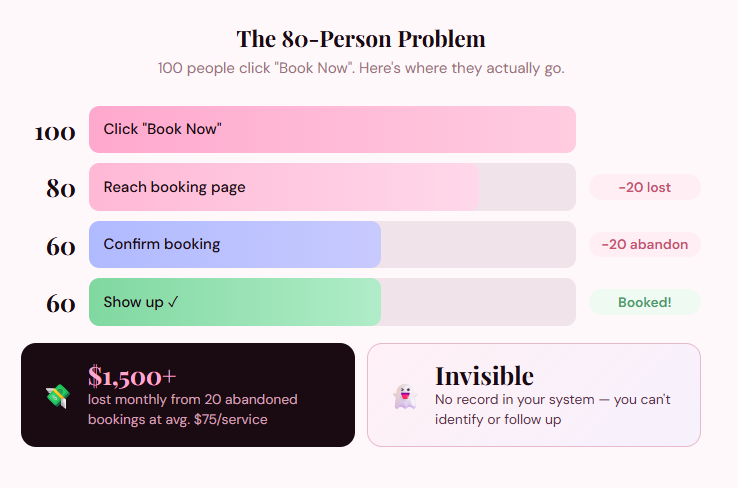
Let's say you're running a promotion this month and you're driving traffic through multiple channels such as Instagram ads, Google Ads, and some local Facebook targeting. Over the course of 30 days, 100 people click your "Book Now" button from these various marketing sources.
The First Drop-Off: Getting to the Booking Platform
Of those 100 clicks, about 80 people actually make it to your booking software's landing page. The other 20 drop off immediately for various reasons:
- The page loads too slowly on mobile
- The redirect doesn't work properly
- They get distracted by a phone call or text
- The booking page looks unprofessional or suspicious
- They clicked accidentally
This 20% loss before even starting is frustrating, but it's somewhat visible. If you're using Google Analytics with proper event tracking, you can see that 100 people clicked the button but only 80 made it to the next page. You know there's a problem with the handoff.
The Second: Booking Funnel Drop-Off
Now you have 80 people who successfully landed on your booking software. They can see your services, your calendar, your pricing. They're in the system.
Of these 80 people:
- 60 complete the entire booking process and confirm appointments
- 20 start the process but abandon it somewhere along the way
These 20 people might have:
- Selected a service and then seen the price was higher than expected
- Checked the calendar and found no availability that worked for their schedule
- Started entering their information but decided the form was too long
- Gotten to the payment screen and felt uncomfortable entering credit card details
- Been interrupted and meant to come back later but forgot
- Decided they wanted to think about it and closed the browser
It's worth noting that mobile users abandon at 85.65% compared to 73.76% on desktop and most of your clients are booking from their phones.
What You Can Actually See
Looking at your analytics at the end of the month, here's what your data shows:
✓ Marketing platform: 100 clicks to booking link
✓ Booking software: 60 confirmed appointments
You can calculate that you had a 60% conversion rate from click to booking, which doesn't sound terrible. Many industries would be happy with 60% conversion.
What You Cannot See
- Who those 20 people were who abandoned inside the booking system
- What specific step they abandoned at
- Whether it was service selection, calendar availability, information entry, or payment
- What their contact information was
- Whether they're in your local area or just browsing from somewhere else
- If they went to book with a competitor instead
- Whether they're still interested and just need a follow-up
Those 20 people paid the same acquisition cost as the 60 who booked. You spent money on ads to get them there. They had enough intent to click through and start the process. They were warm leads.
But they're gone, and you have no way to recover them because you don't know who they are.
Why This Data Gap Exists
This isn't an accident or oversight. It's a consequence of how these business systems evolved.
Booking Platforms Were Built for Operations, Not Marketing
Mindbody launched in 2001. Vagaro came out in 2009. These platforms were created to solve a specific problem: managing appointments for service businesses. They needed to handle scheduling, prevent double-bookings, process payments, track client history, and send reminders.
They weren't built to capture leads or track marketing funnel conversion. Their core purpose was operational efficiency, making it easier for salons to manage their day-to-day appointment book.
For this purpose, they only need to create records when appointments are confirmed. An incomplete booking attempt doesn't affect your schedule, doesn't require a reminder, doesn't need to be tracked. From an operational standpoint, it's irrelevant.
Marketing Platforms Can Only Track Their Own Domain
Marketing analytics tools like Google Analytics, Facebook Pixel, or Zoca's tracking can only monitor activity that happens on domains they control or where their tracking code is installed.
When someone clicks a link that sends them to a third-party domain (your booking software), the marketing platform loses visibility. Some information can be passed through URL parameters, but detailed behavioral data about what someone does on that third-party site isn't accessible.
This is actually a privacy feature, not a bug. Booking platforms don't allow external tracking scripts to monitor what happens inside their system. They control their own data environment, and they don't share detailed session information with external platforms.
For booking platforms to provide abandonment data to marketing platforms, they'd need to:
- Build and maintain APIs specifically for this purpose
- Track user sessions even when bookings aren't completed
- Handle data privacy implications of sharing partial booking attempts
- Provide real-time or near-real-time data sync
- Support integration with multiple marketing platforms
This is significant development work. And what's the business case for doing it?
Booking platforms make money through monthly subscriptions or per-appointment fees. Whether you convert 30% or 80% of your booking attempts doesn't change their revenue. They get paid based on completed bookings, not on how well you optimize your funnel.
From their perspective, building abandonment tracking and marketing integration doesn't directly benefit their business model. It would be a feature that helps their customers (you) market better, but it doesn't help them sell more subscriptions or process more appointments.
So it doesn't get built.
The Result: Permanent Data Silos
You end up with two systems that both hold critical pieces of information but neither has the complete picture:
| Marketing Platform Data | Booking Platform Data | Missing Data (The Gap) |
|---|---|---|
| Traffic sources | Completed appointments | Who initiated booking but didn't complete |
| Click-through rates | Client service history | Abandonment step-by-step breakdown |
| Landing page performance | Payment information | Cart/booking value of abandoned attempts |
| Overall conversion rates | Rebooking rates | Reasons for abandonment |
This missing data is precisely what you need to optimize your conversion and recover lost revenue, but it's invisible to both systems.
When you can't see booking abandonment, you can't address it. And that has real financial implications.
Revenue Loss
Using our earlier example: 20 abandoned bookings per month, average service value of $75.
That's $1,500 in monthly revenue from people who were ready to book. Over a year, that's $18,000 in direct lost revenue.
But it's actually worse than that, because this calculation only accounts for the initial appointment. It doesn't factor in:
- Lifetime value of clients who might have become regulars
- Additional services they might have added during their visit
- Retail products they might have purchased
- Referrals they might have sent you
- Positive reviews they might have left
A single client isn't worth just their first $75 appointment. A regular client who visits every 6 weeks for five years is worth thousands of dollars in lifetime value.
When you lose 20 potential clients per month to invisible abandonment, you're not losing $1,500 - you're potentially losing tens of thousands in long-term value.
The Real Solution: Connected Systems
The fundamental issue is architectural. You have disconnected systems trying to handle a connected customer journey.
There are only two real solutions:
Solution 1: Booking Platforms Share Abandonment Data
Imagine if Mindbody, Vagaro, and other booking platforms provided APIs that sent abandonment data back to marketing platforms.
Every time someone initiated a booking but didn't complete it, the booking platform would send:
- Session identifier
- Partial information entered (email, phone if captured)
- Services viewed
- Date/times checked
- Step where abandonment occurred
- Timestamp of abandonment
Marketing platforms could then use this data to automatically trigger follow-up. Smart recovery emails, SMS reminders, personalized assistance - all based on knowing exactly where and why someone dropped off.
This would be the ideal solution if you're committed to using separate marketing and booking platforms.
Solution 2: All-In-One Platforms That Handle Both Marketing and Booking
The better solution - and the direction the industry is moving is platforms that manage the entire client journey in one system.
Instead of:
Marketing Platform → Handoff → Booking Platform
You have:
Integrated Platform (Marketing → Booking → Retention)

When everything happens in the same system, there's no data gap. The platform can see:
- How clients discover you (Discovery)
- How they engage before booking (Conversion tracking)
- What they do inside the booking process (Complete session data)
- Where they abandon and why (Abandonment analytics)
- Who they are even if they don't complete (Lead capture)
- How to follow up effectively (Automated recovery)
- What happens after their appointment (Retention and rebooking)
This is the approach Zoca is taking, and with discovery, conversion, bookings, and retention in one unified platform. This way, no booking goes abandoned with you having full visibility on who enters your booking flow and with the AI Front Desk Agent answering calls immediately, assisting clients in completing the booking.
How Zoca Addresses the Data Gap
Zoca started as a marketing platform focused on three areas: Discovery (getting found), Conversion (turning interest into bookings), and Loyalty (bringing clients back).
Discovery Agent handles your Google Business Profile, social media, reviews, and local SEO.
Win Agent captures leads and converts them into appointments.
Loyalty Agent manages post-service communication and rebooking.
This worked well for what it was designed to do. But we kept running into the same limitation: the handoff to external booking platforms created a data gap we couldn't bridge.
If someone clicked a booking link from Zoca but abandoned the booking in the booking platform, we had no visibility into who they were or what happened. We could see the click but not the abandonment. We couldn't follow up effectively because we didn't have the data.
That's why we made the decision to build booking and payment capabilities directly into Zoca.
This is the approach Zoca is taking, and with discovery, conversion, bookings, and retention in one unified platform. This way, no booking goes abandoned with you having full visibility on who enters your booking flow and with the AI Front Desk Agent answering calls immediately, assisting clients in completing the booking.
What This Means in Practice
When bookings happen inside Zoca instead of being handed off to a separate platform, the entire client journey is visible in one system.
With complete funnel visibility, you’ll see:
- How many people clicked your booking link
- How many made it to the booking page
- How many started selecting services
- How many checked calendar availability
- How many began entering information
- How many reached the payment step
- How many completed and confirmed
At each step, you'll know the exact count and the specific people involved. No more black box.
When someone starts booking but doesn't finish, Zoca's Agents know immediately. It knows who they are (from information already entered or session tracking), what service they were looking at, what date/time they checked, and where exactly they stopped
Based on this information, it can automatically send an intelligent follow-up:
- If they abandoned at service selection: "Still deciding? Here's what each service includes..."
- If they abandoned at calendar: "Didn't see a time that worked? We just added more availability..."
- If they abandoned at payment: "Questions about our deposit policy? Here's what you need to know..."
These aren't generic "complete your booking" emails. They're contextual responses to the specific barrier that stopped someone.
Room for Continuous Optimization
Because you have complete data, you can test and improve systematically.
If you see that 40% of mobile users abandon when trying to select a date, you know to improve your mobile calendar interface. If desktop users are completing bookings fine but mobile users drop off at form entry, you know to reduce form fields on mobile.
You can measure the impact of every change because you have before-and-after data on abandonment rates at each step.
The Transition
This isn't about forcing salons to abandon tools they like. It's about offering a complete solution for salons and beauty businesses that want to eliminate the data gap.
If you're happy with your current booking platform and it's working well for you, you can continue using Zoca for marketing while keeping your existing scheduling system. You'll still have some visibility limitations, but Zoca's Win Agent can still help with lead capture and follow-up before the handoff happens.
If you want complete funnel visibility and integrated abandonment recovery, Zoca's booking and payment features give you that option. Everything in one platform, one data source, one place to optimize.
We're building this because we see how much revenue salons and beauty businesses are losing to invisible abandonment. And we see that the data gap between marketing and booking systems isn't going to get solved by hoping existing platforms will integrate better. It requires a different approach.
Stop losing warm leads to a data gap you can't see. Book a demo with Zoca and be first in line to experience discovery, conversion, bookings, and retention in one platform.